Post #12: Fendover activities on board

Since Becky and family all use Charley’s last name, Cover, and the rest of us use Fendel, we referred to our collective family as the Fendovers.

In addition to an assortment of smaller board game activities and such, there were two major all-Fendover activities on board:

  • * Family Feud (done several nights, and based on the old TV show), and
  • * The Fendover Talent show

FAMILY FEUD (from Dan)

Our first Family Feud night included everyone, with Ari as emcee and Amir as his assistant, and two competing teams of six:

  • “The Grands” – that is, grandparents and grandchildren — Dan, Nina, Shoshana, Merrill, Riley, and Phoebe
  • “The Middles” – that is, the six members of the middle generation: Joe and Tamar, Becky and Charley, Ben and Judith

What was fascinating to me was the leveling effect of the game. All were enthusiastic, all able to participate, and all came up with answers that others didn’t think of. (I’m hoping one of us has photos from this to add.) I no longer remember who won.

THE FENDOVER TALENT SHOW

(Discussion of this concept began well before we sailed, and some people had “acts” that they had planned in advance. Others were more spontaneous.)

Here’s the Fendover Talent Show Program

HOST: Ari Fendel
1. Skit – Middles
2. 3 songs – Merrill, Riley, and Phoebe
3. Skit – Joe [He brought his Kermit puppet along on the voyage just for this.]
4. Song – Saba [That’s Hebrew for “Grandpa” — otherwise known as Dan]
5. Magic – Riley 
6. Song – Shoshana
7. Verbalization – Riley
8. Magic – Amir
9. Columbus song – Nana, Merrill, Riley, and Phoebe

ABOUT THE TALENT SHOW,
by Riley, Age 10

The family talent show was a great idea because everybody got to show off their skills. I want to thank Nana for encouraging it and everybody for sharing their talents. It was really fun!

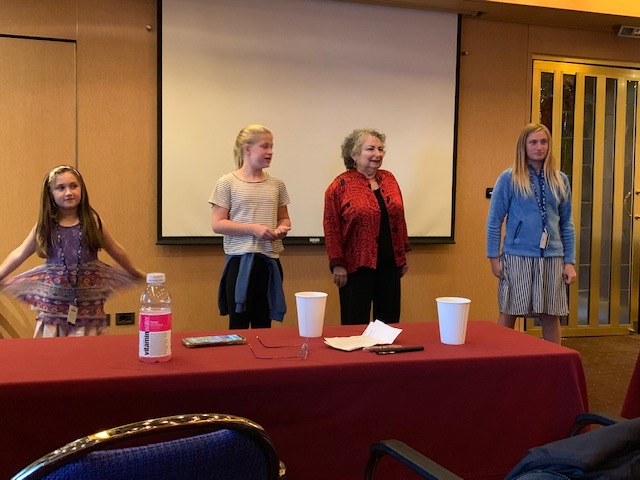
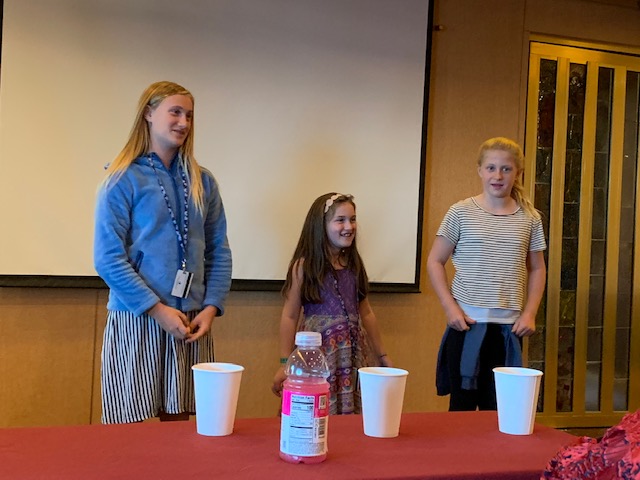
Nina adds: Everyone participated, which was so fun. Merrill, Riley, and I (with backup from Phoebe) worked out 3-part harmony and choreography to Nancy Schimmel’s wonderful song “1492” (aka “And Someone Was Already Here”) about Columbus’s voyage and the North American Indian tribes.
Dan adds: My song was an update of a song my father sang to my brother and me as a lullaby when we were young, “When I was single,” to the same melody as the Israeli national anthem, Hatikvah. (I’ve never known where he got the song from, or whether the lullaby was based directly on the folk melody on which Hatikvah drew, rather than an adaptation based on Hatikvah.)

My new version recounted the growth of my family from the original three children to the current 6 “middles” and 6 grandchildren.
Post #11: Juneau Museum

The stop at the fish hatchery in Juneau (see post #10 from Ben) was part of a bus tour around Juneau that most of us did. This bus tour also included an hour or so at the excellent Juneau Museum, which included exhibits about the evolution of the land — ice ages and all that — and some wonderful child-friendly interactive activities.

One take-away I had from the discussion of ice ages was the recognition that climate change is not a new phenomenon. Only a few hundred years ago, the Tlingit were forced to retreat to the south from their lands because of oncoming glaciers, and then were able to return gradually as the glaciers retreated. Although we heard extensively about the current retreat of the glaciers, and know that human development is largely responsible, the Museum exhibit reinforced my sense that nature has often done her own thing, independent of what we humans do or don’t do.

Post #10: Macaulay Salmon Hatchery – Juneau

From Ben – August 7th

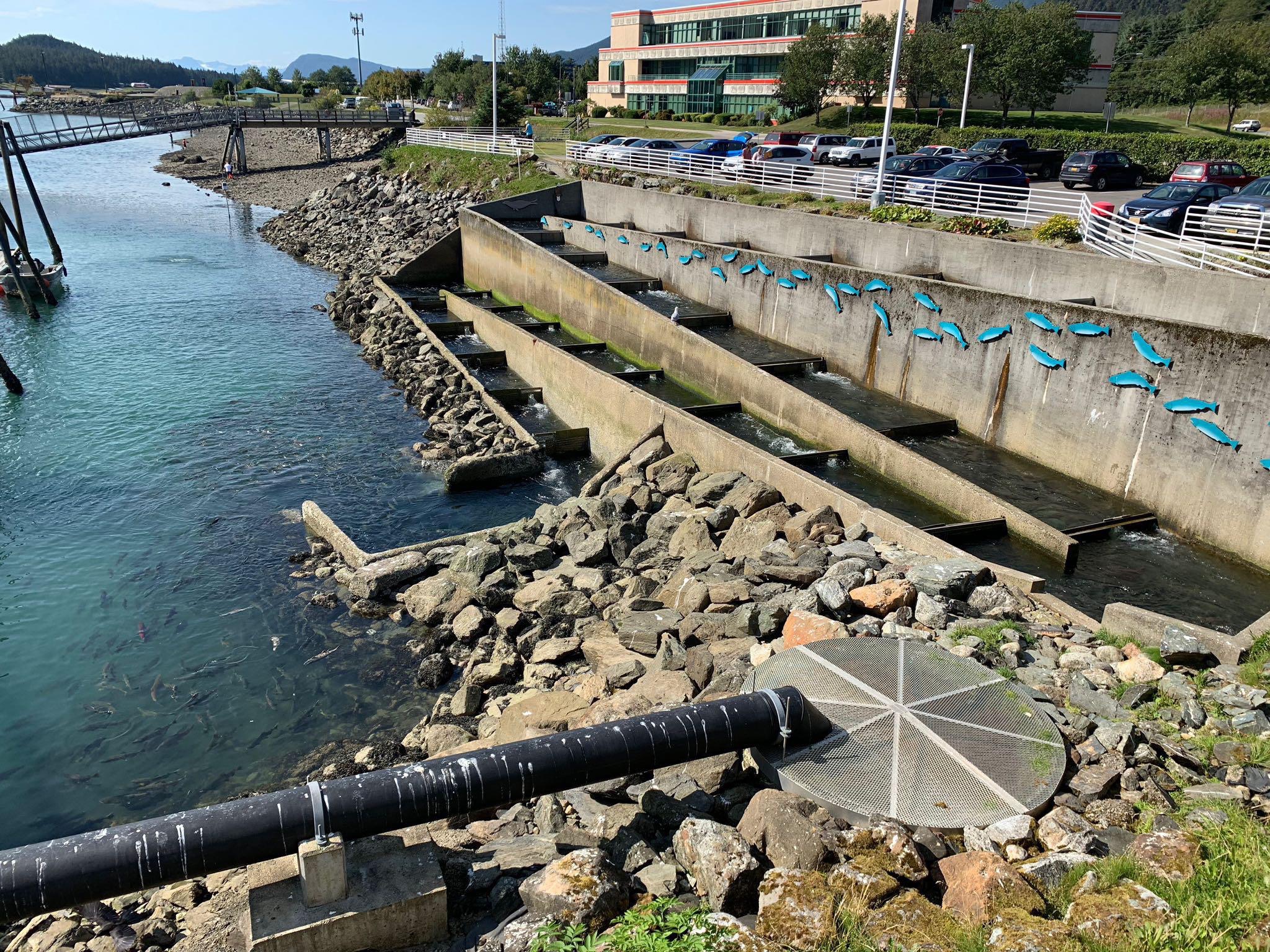
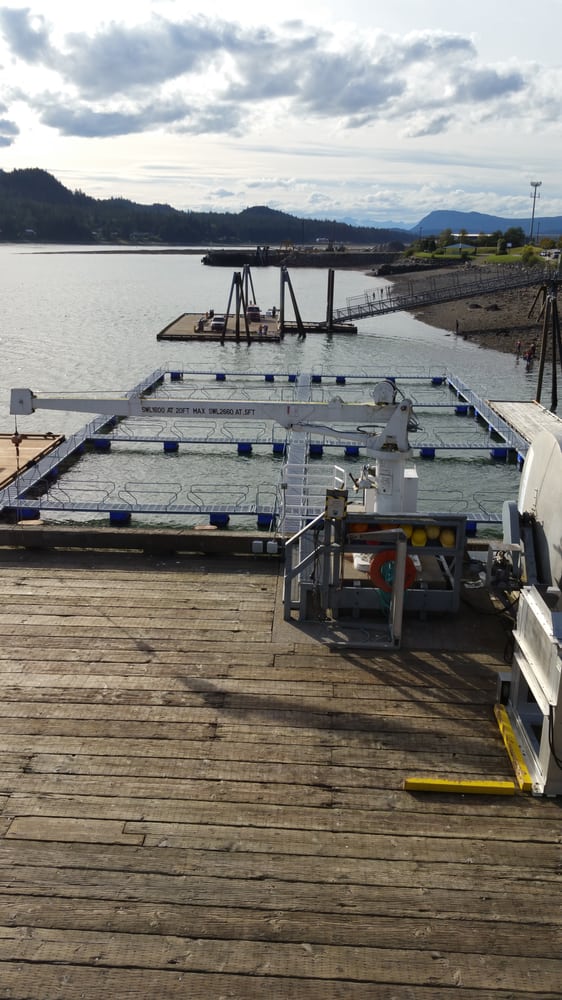
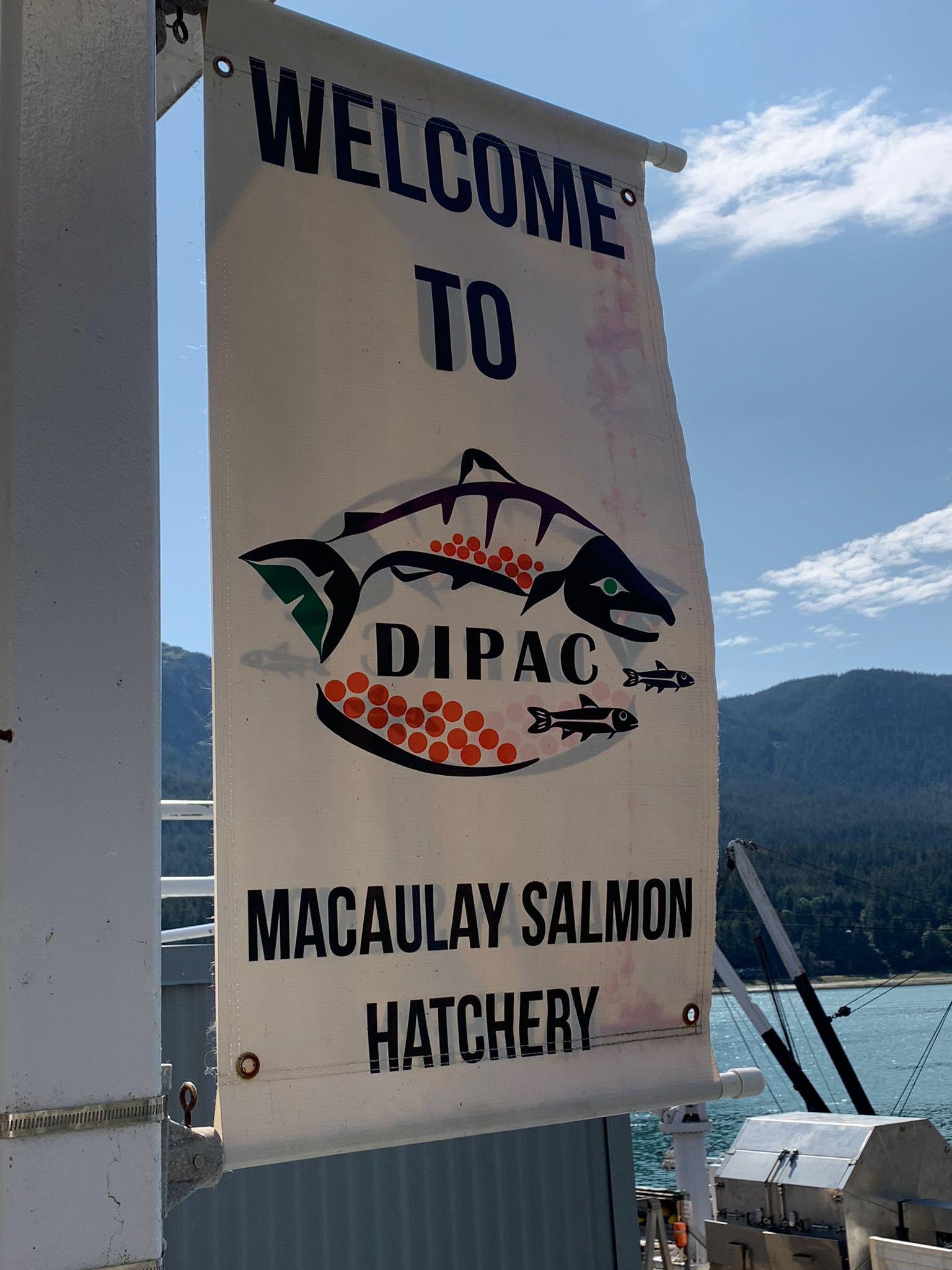
During our second port stop in Juneau, we had a chance to visit the Douglas Island Pink and Chum (DIPAC) Salmon Hatchery. The goal of the non-profit hatchery is to raise and release millions of salmon into the Alaskan waters. Salmon are an incredibly important part of Alaska’s economy and culture, and the Hatchery was created in 1976 by the residents of Juneau in response to the increasing depletion of the salmon resources.

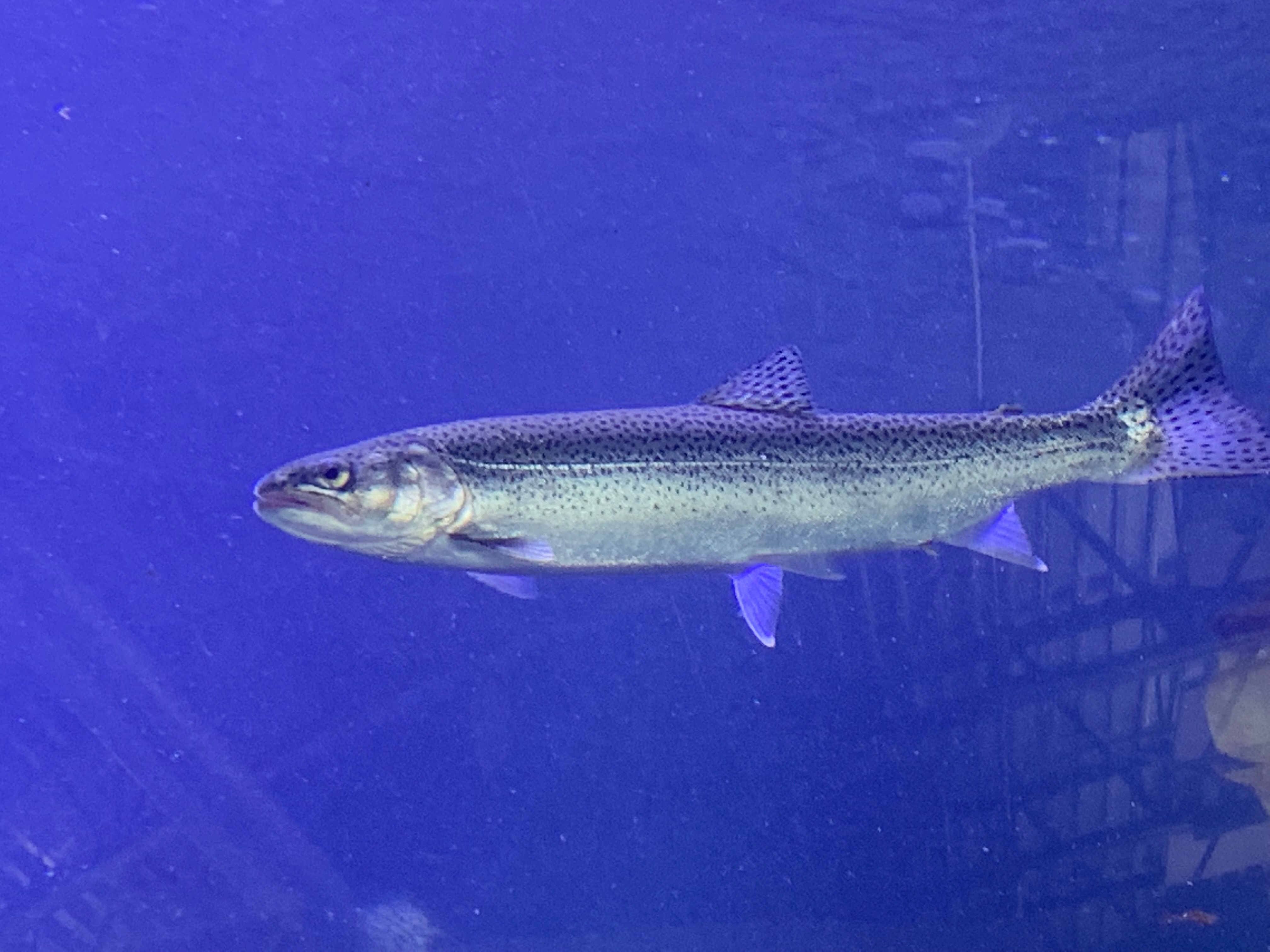
DIPAC currently incubates, rears, and releases four species of Pacific salmon: chum, chinook, coho, and sockeye. In all, the hatchery raises more than 130 million salmon each year, and provides an opportunity for visitors to see the operations of an active hatchery.

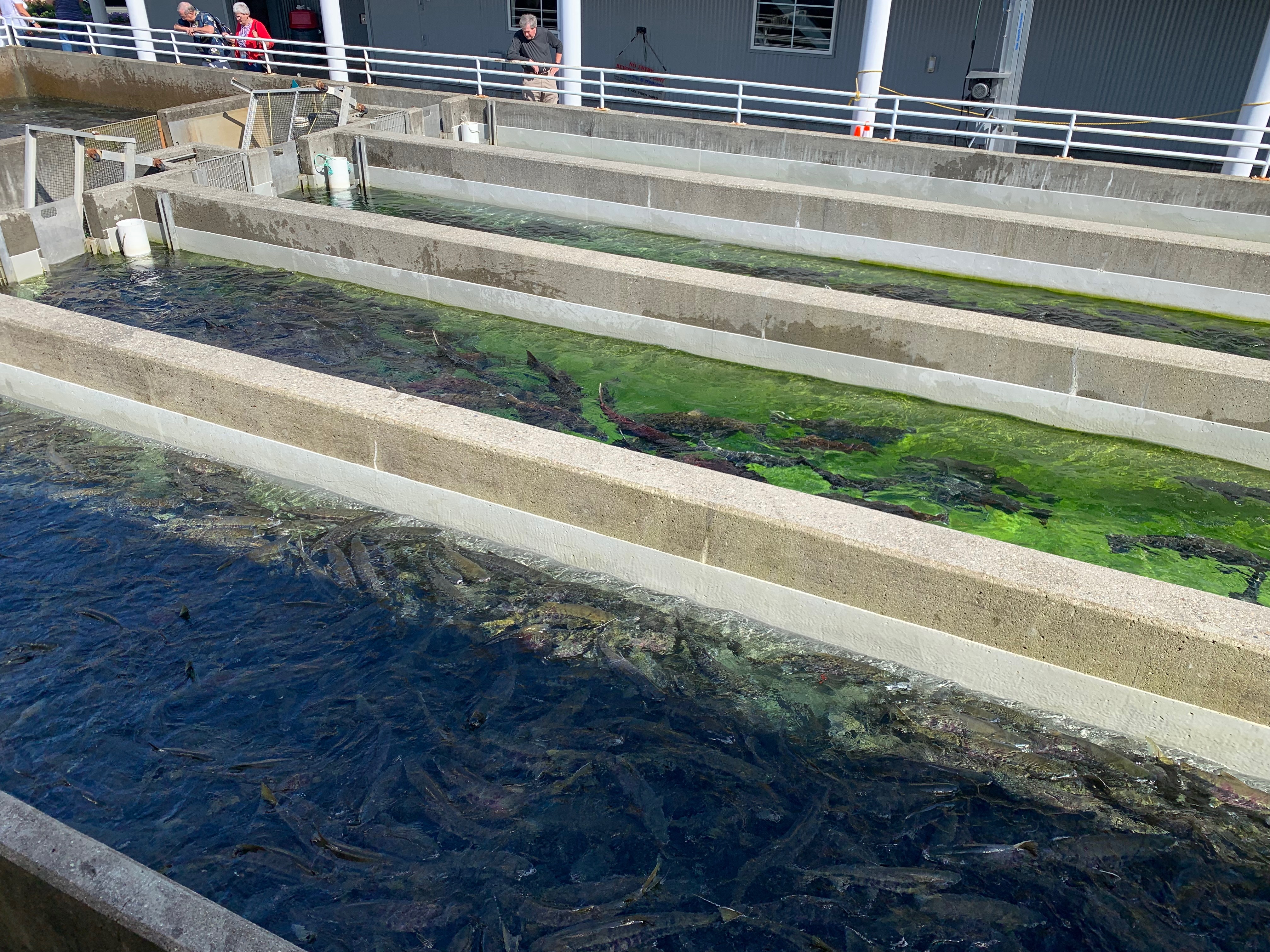
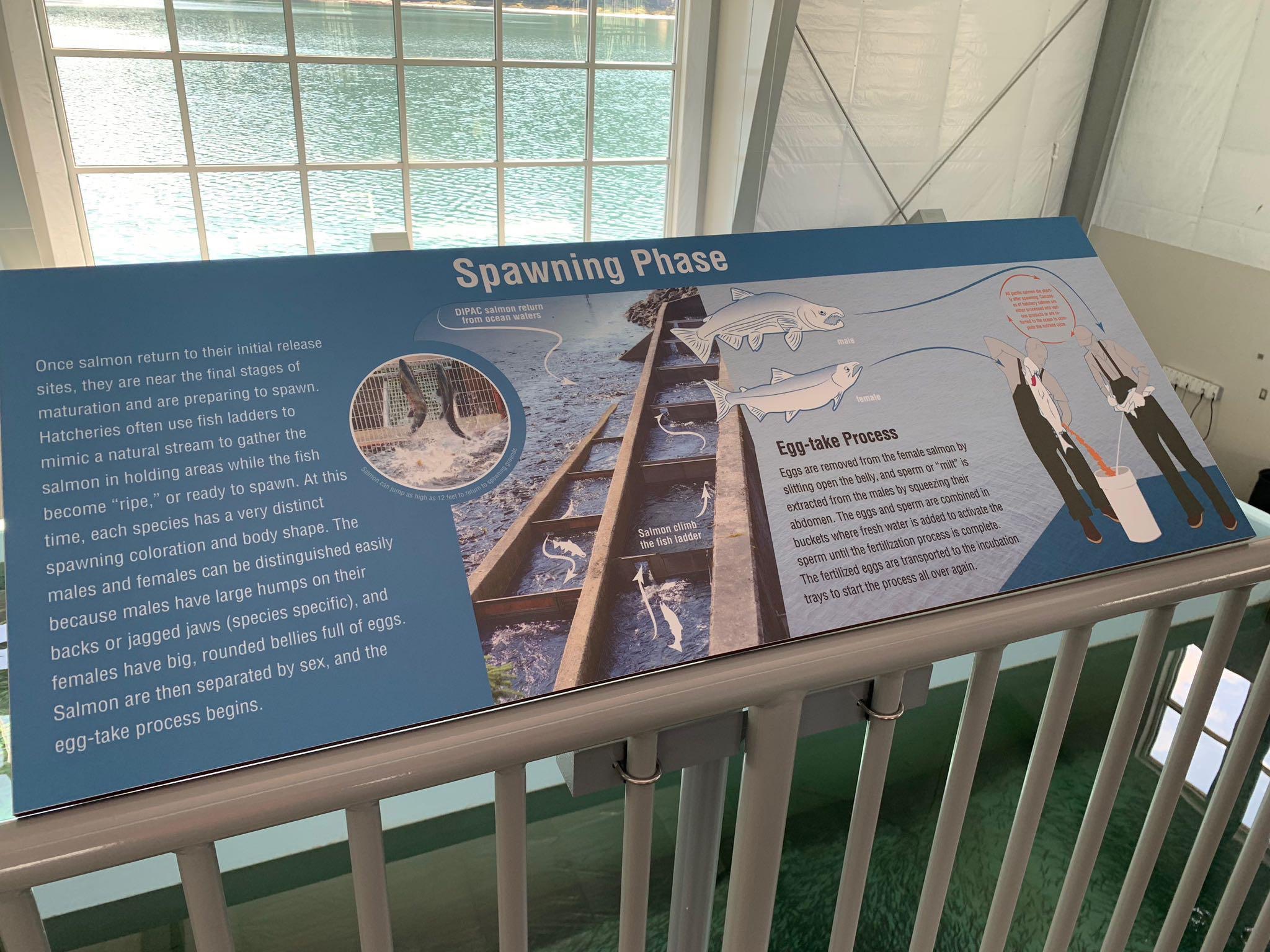
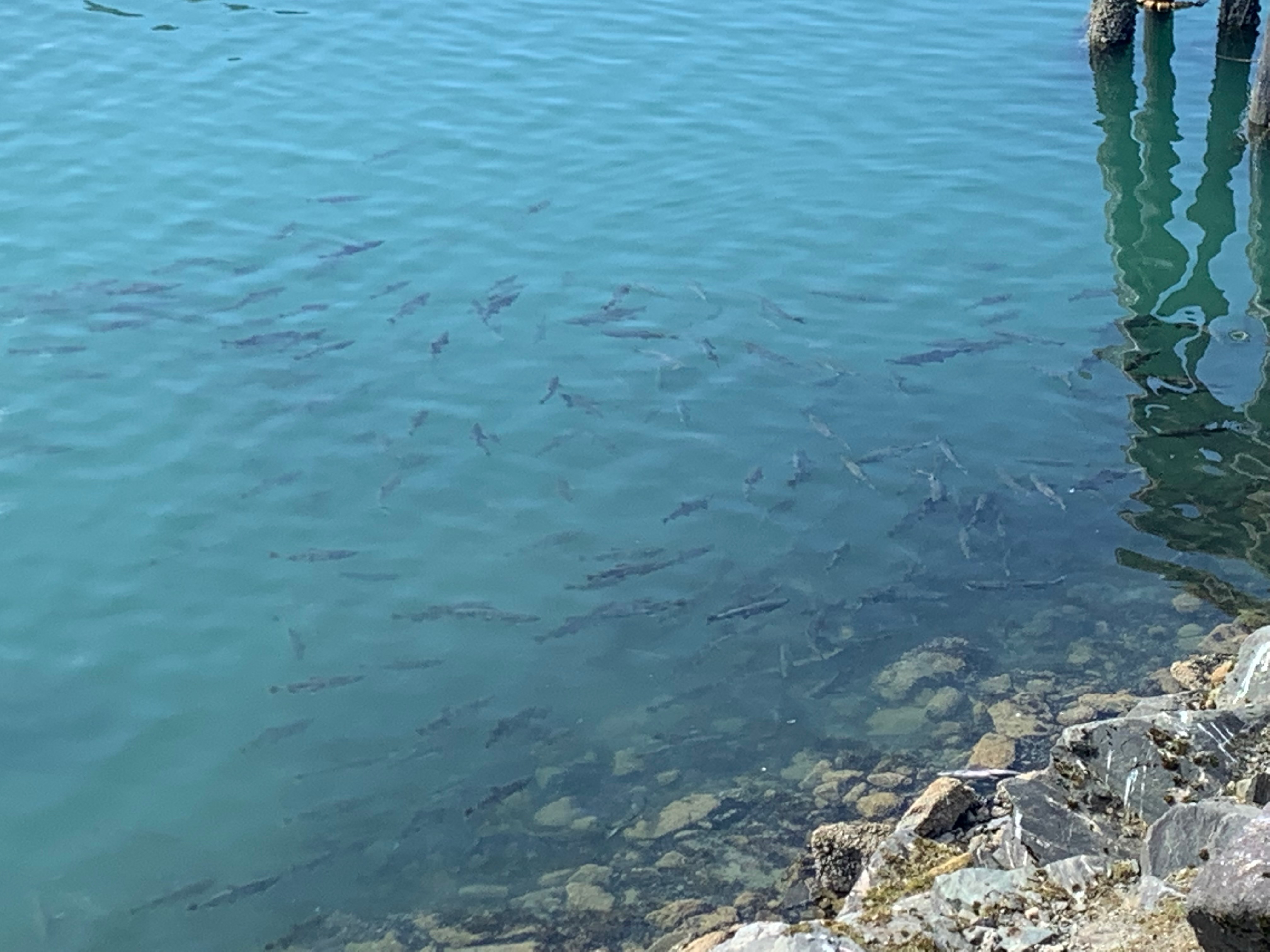
During the summer months, thousands of adult salmon, who were born here years earlier and have spent their lives living in open waters as far as Japan, return here on their own when they are ready to have their babies. They make their way up the salmon ladder, designed intentionally challenging to encourage survival of the fittest.

After they’ve made it through the tough uphill climb, they are collected in large ponds, where they will spend their final days before their babies are spawned.

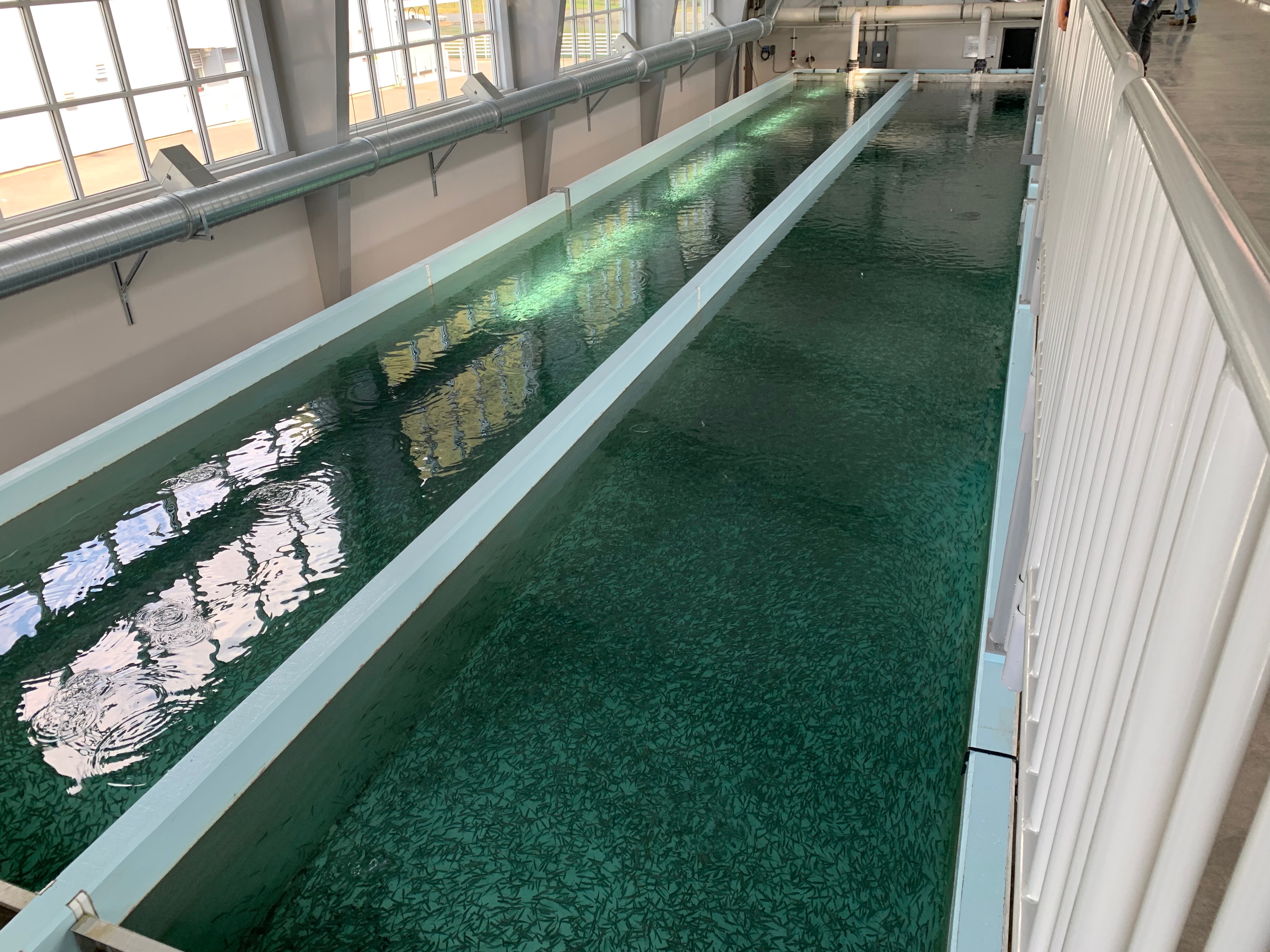
Their eggs and sperm are collected, fertilized, and hatched. The baby salmon are carefully fed and raised in giant indoor tanks, specific to the salmon’s various ages, until they are 2-3 years old.

Once they are old enough, they are moved into outdoor holding ponds, where they spend a few months getting adjusted to the saltwater, and where they will magically “imprint” on the exact conditions of the water. It’s this incredible imprinting that will allow them to return to this exact location years later to have their babies.

After a few months in the outdoor tanks, they are released into the open waters. Most do not return, but become part of Alaska’s incredible salmon fishing economy. Roughly 1% will eventually return to the Hatchery to have their babies, continuing this amazing cycle of salmon life.

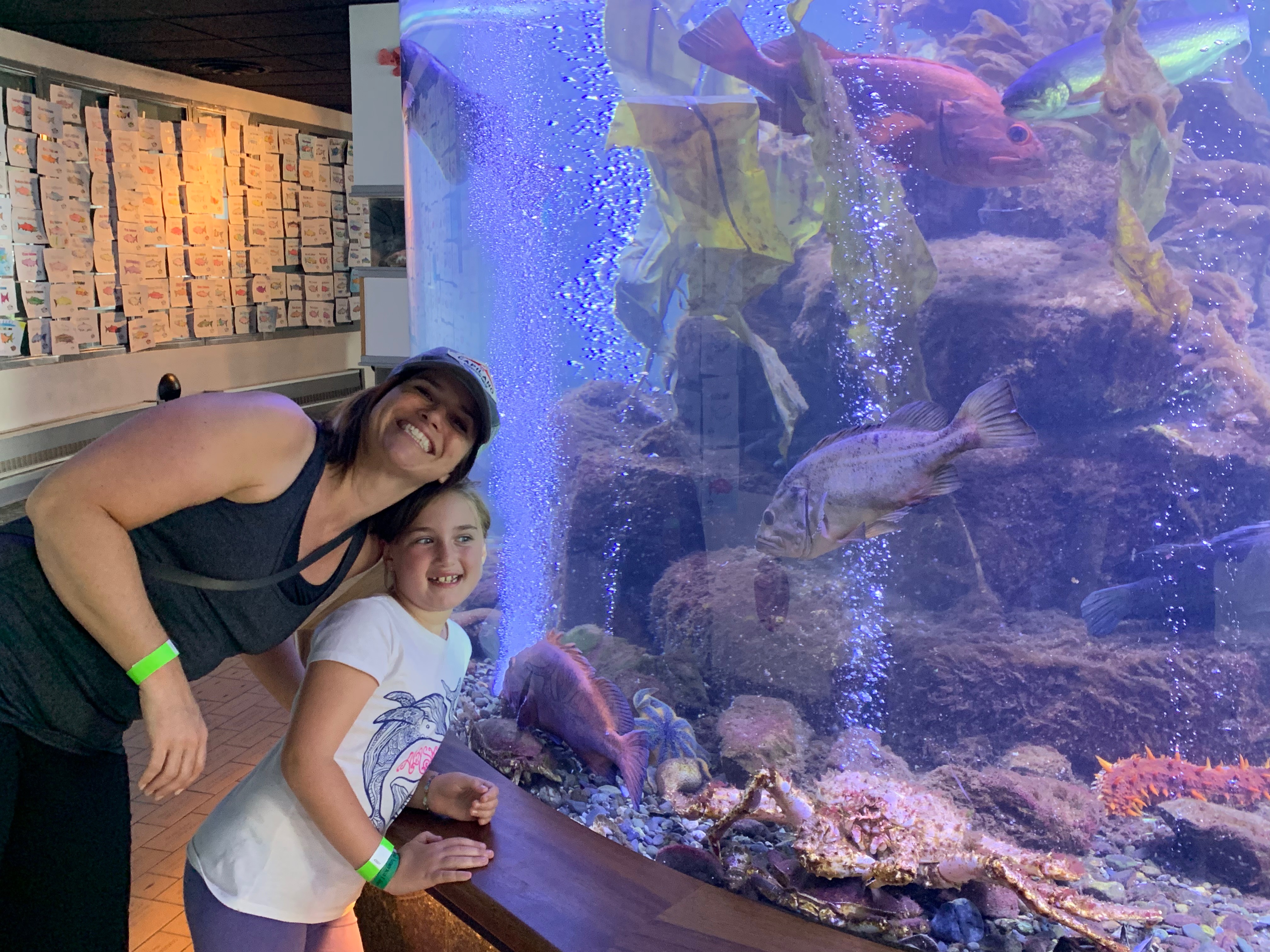
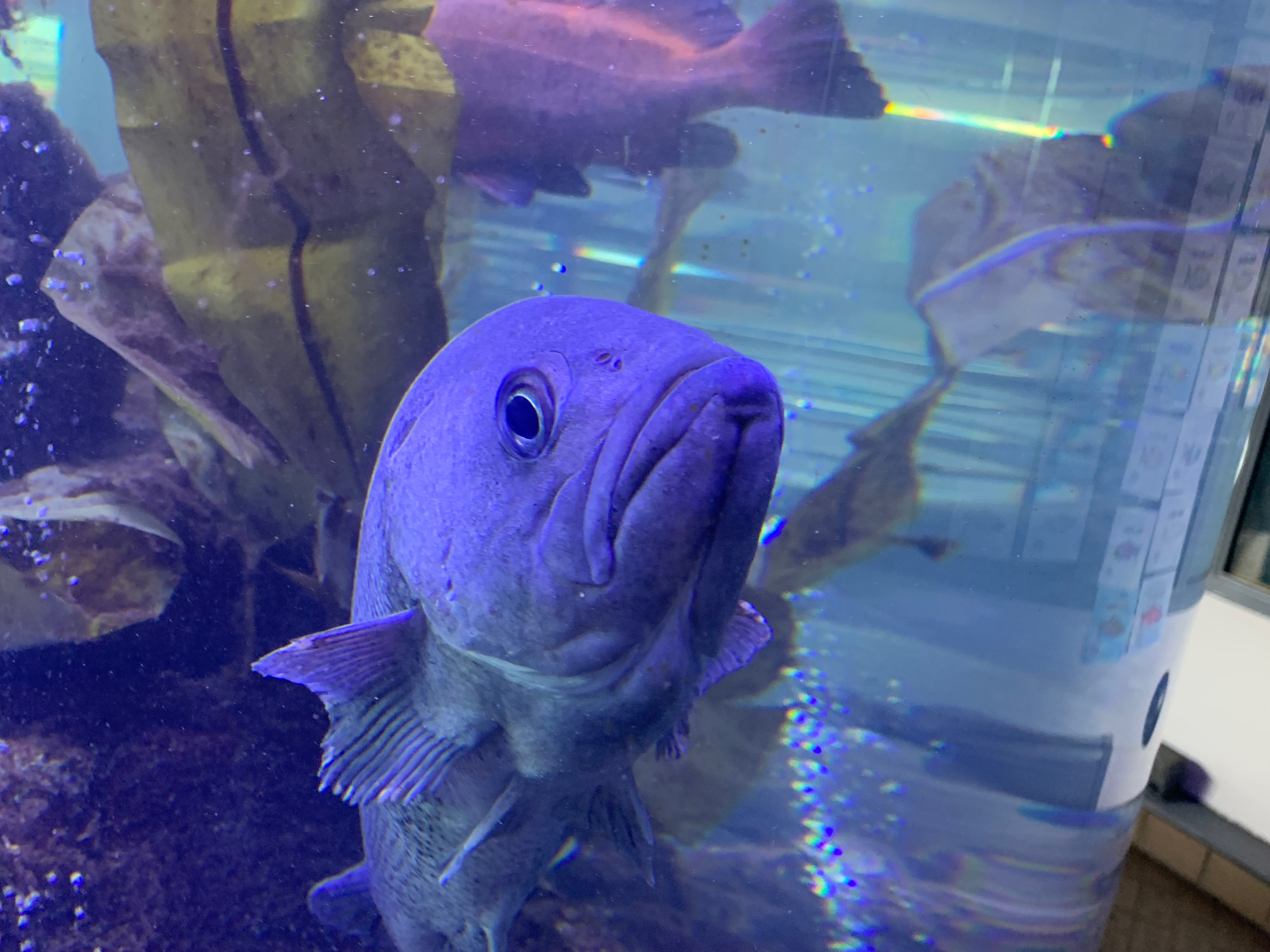
The visitor center also of course features a wonderful gift shop, plenty of salmon souvenirs, a beautiful aquarium, and some really awesome touch-tanks.

The Hatchery was a really cool place for adults and kids alike, and was one of the most interesting places we enjoyed on this trip!

Post #9: Hiking in Juneau/Climbing Mt. Roberts

BY CHARLEY:

On the morning of 8/7, we landed in Juneau and all took the tram up Mt. Roberts.

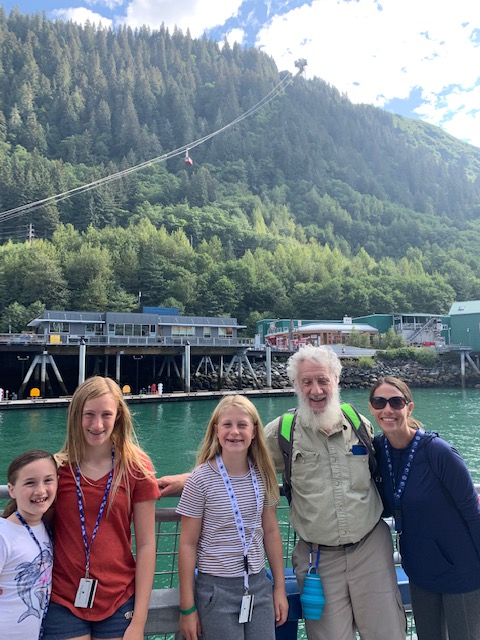
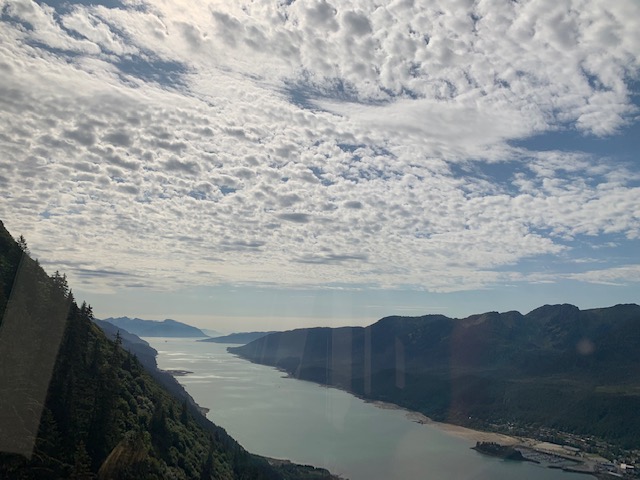
Here’s some of us at the Juneau dock, with the tram behind us, and then a view from the tram:

The tram took us to the Mountain House and Nature Center (1750′) where we saw a quick movie, an inspiring story of the area and the Tlingit people.

(From Dan: Here’s some of us assembled at the top of the tram: Joe, Shosh, and Ari in front; some others in the backgrond to the right)

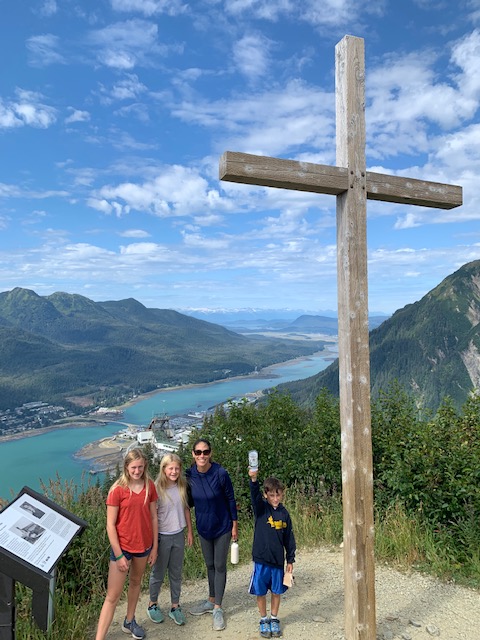
(Back to Charley:) The entire group did a very steep nature loop on the mountain. Here’s Father Brown’s cross (2030′):

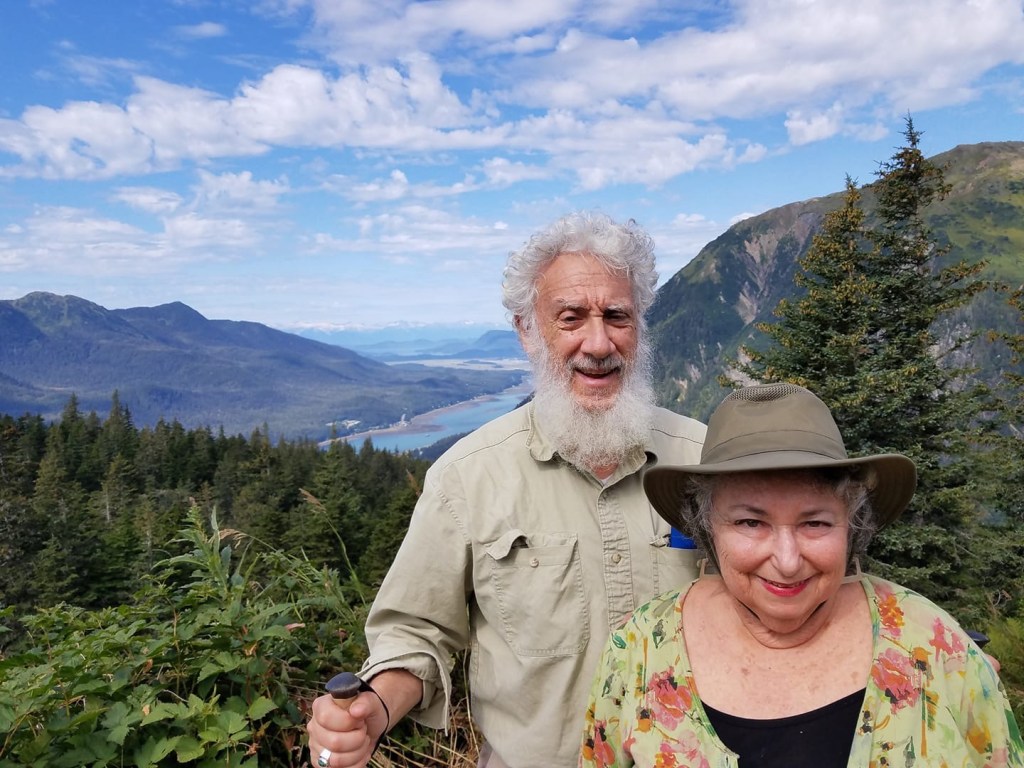
(From Dan: Some of you may have seen Joe’s FB post of the next photo, in which he said “Reflecting on how wonderful it is that my parents still climb mountains.”)

<Charley continues:)

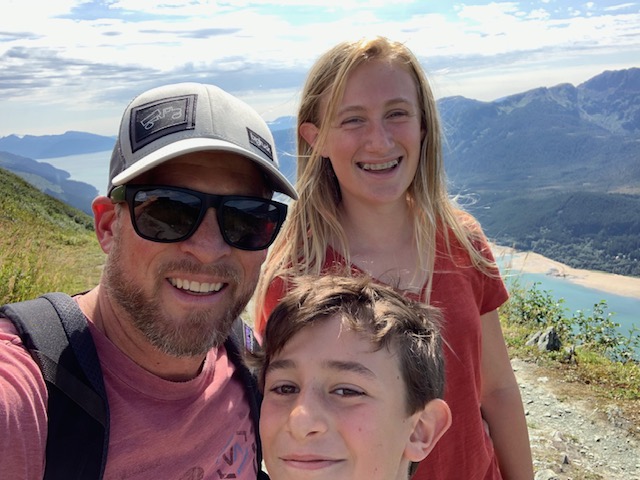
Then Amir, Merrill, and I continued up past the Dwarf Spruce Switchbacks, nearly to the top of the mountain, Gold Ridge (about 3150′).

This is the three of us:

“At Dwarf Spruce switchbacks”

“Merrill: Don’t Fall!”:

“Snow in the distance”:

“Happy I had two strong kids to push me to the top”:

“Let’s go down”:

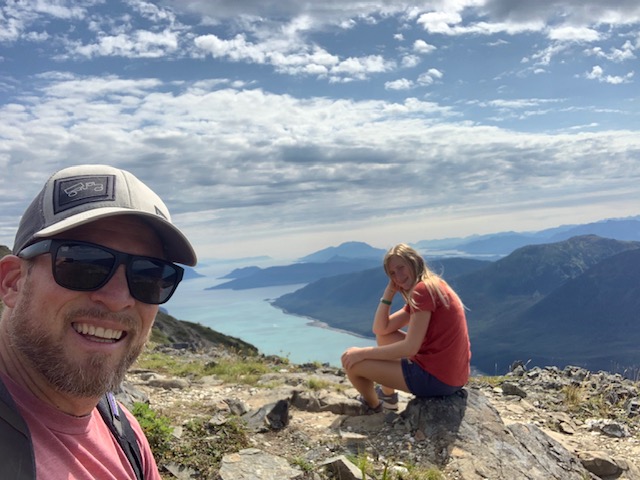
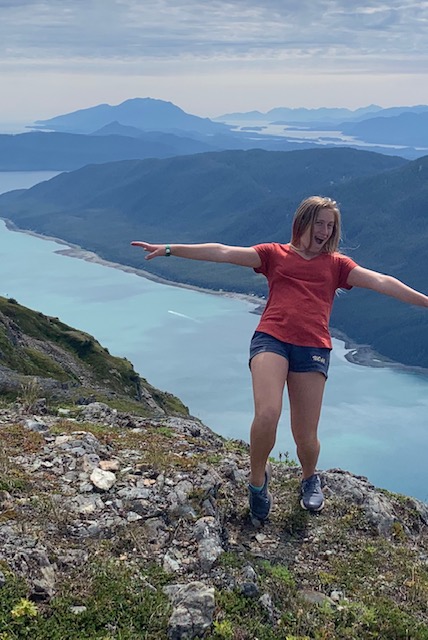
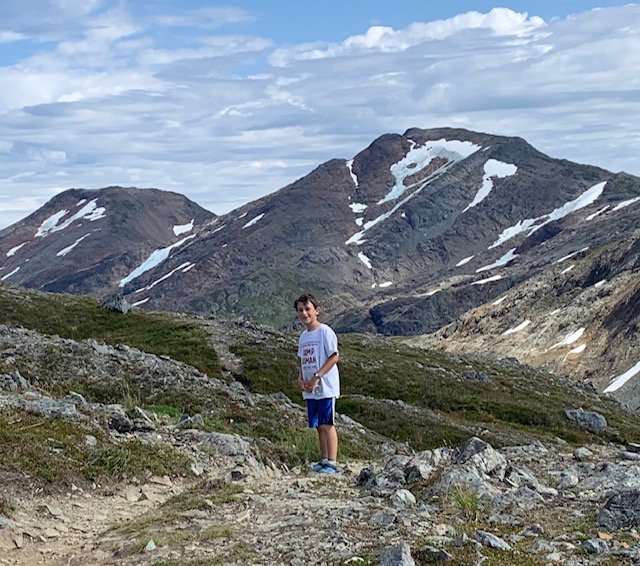
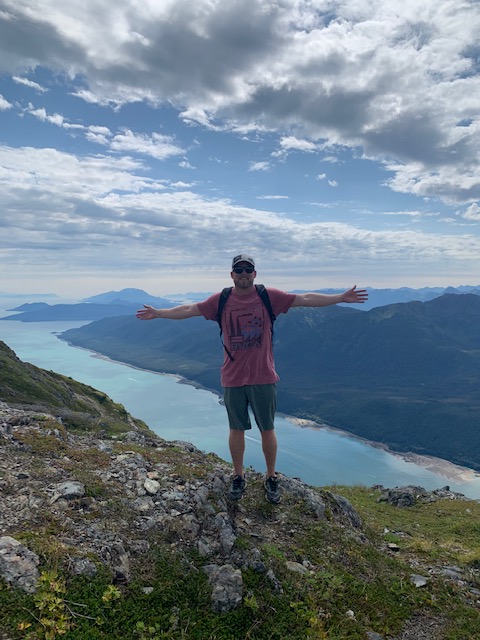
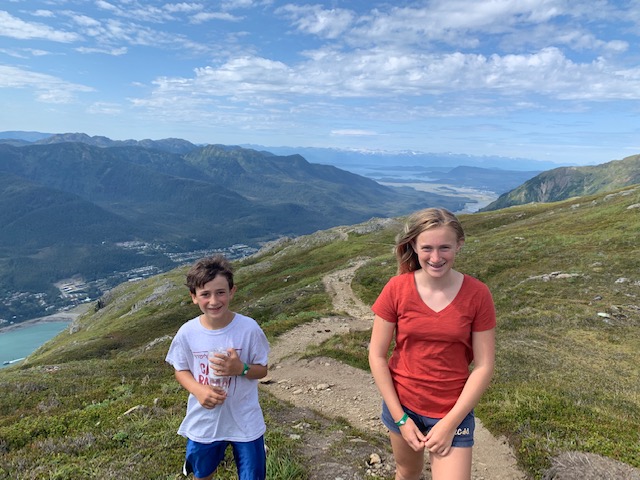
It was a grueling climb and we found ourselves looking down at the seaplanes. It was a glorious view of the Gastineau Channel below. Spirits were tested, legs were sore, but we all made it back with big smiles and hungry bellies. The area is known for Black Bears and there were accounts from hikers on the trail of Black Bears earlier in the morning. Merrill and Amir headed up as cousins and came back more like siblings, wrestling and all.

Post #8: Ketchikan

<from Dan, except for italics>

Back to the week of the cruise:

Our first port of call was Ketchikan (on 8/6), which we reached after a day and a half of sailing from Vancouver. But before getting to that, I want to add one more shipboard shot:

When we went on shore in Ketchikan, the hardy and intrepid among us (Joe, with Shosh and Ari, Becky and all her family, and Ben) went ziplining for the morning. (Amir really wanted to go but didn’t meet the minimum weight requirement!)

Ari has already posted about this, so I’ll add just one photo he didn’t include:

Meanwhile, the rest of us wandered around town. There’s a stream in the middle of town, and we saw lots of salmon swimming upstream (or, more accurately, swimming facing upstream but not seeming to get anywhere).

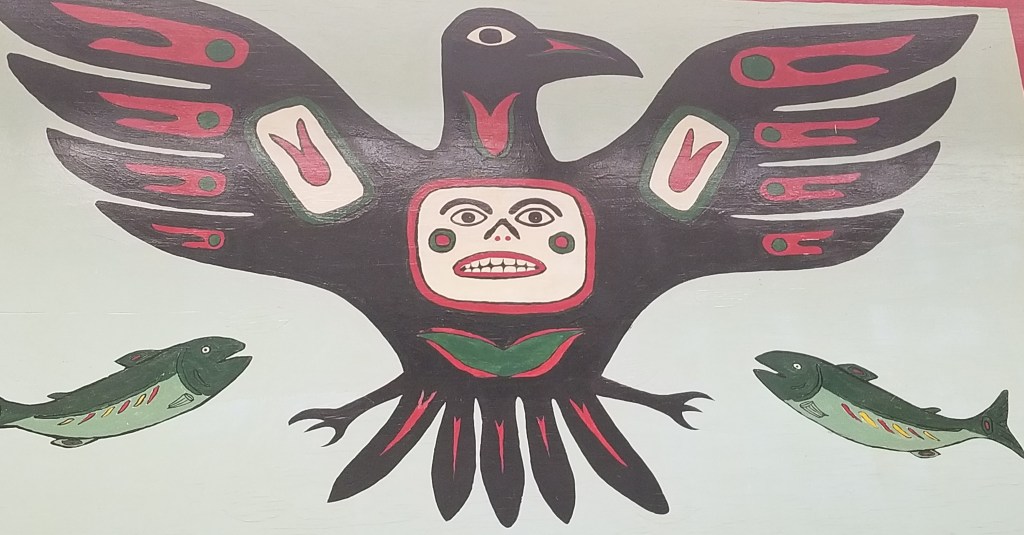
Nina found a beautiful eagle-and-raven bracelet in one of the Ketchikan shops. The eagle and raven represent the two clans of the Tlingit tribe. Everyone belongs to one clan or the other, and they can only marry someone of the opposite clan, so the combination has a kind of “love bird” sense. I bought Nina a ring with the eagle-raven motif for our first anniversary many years ago.

The ring is by Larry Taranoff, one of the most famous Tlingit jewelry makers. He uses tribal, clan, and family symbols in his work.

NOTE FROM NINA ON CULTURAL APPROPRIATION.

I‘ve always found it hard to feel like I really understood the concept of cultural appropriation. I saw it in action in Alaska. Here, Larry Taranoff is revered by those familiar with his work. Now, In addition to family and tribal followers, many non-native jewelry artists have adopted Taranoff’s designs. I felt sad when I realized that some of the people selling these derivative designs didn’t know who Larry Taranoff was. Cultural appropriation in action, I think.

VISIT TO SAXMAN INDIAN VILLAGE

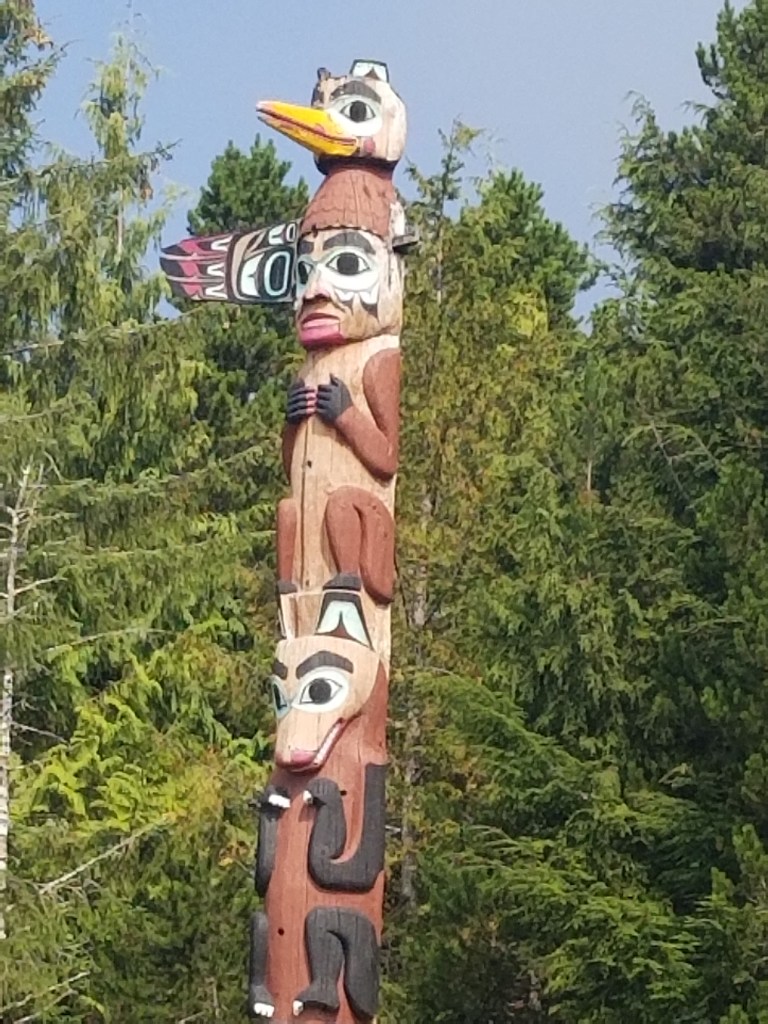
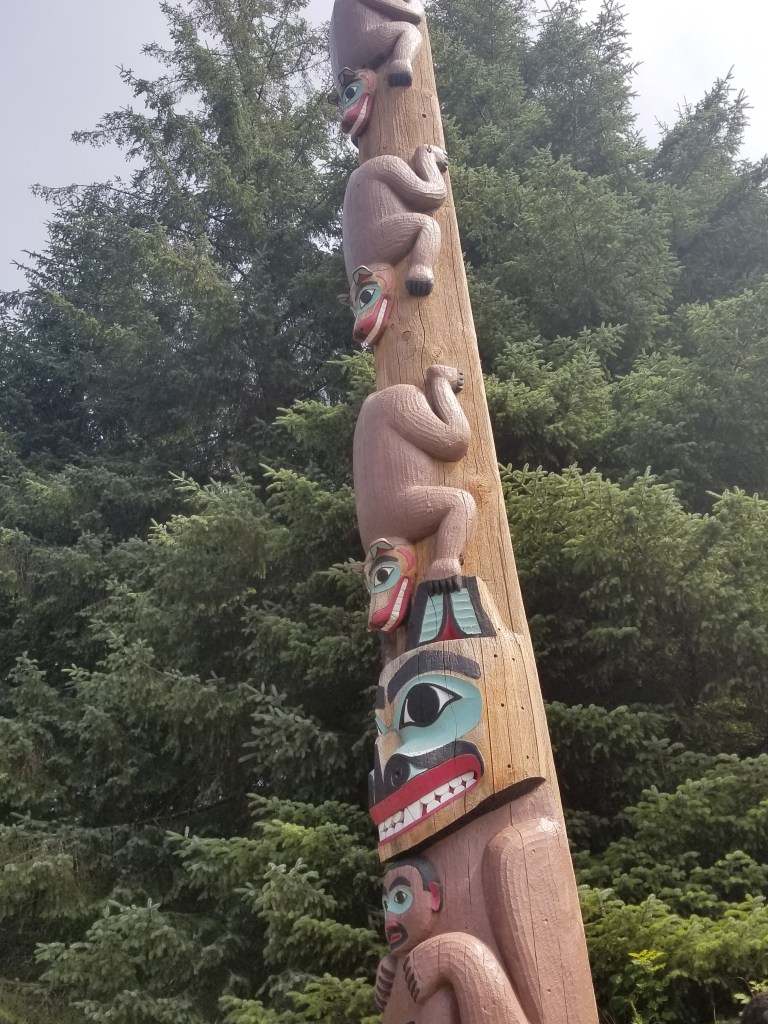
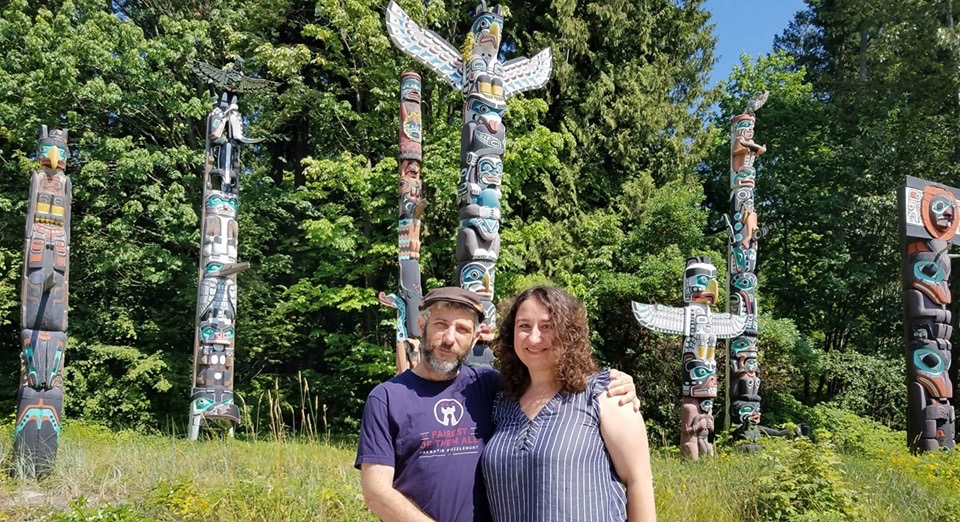
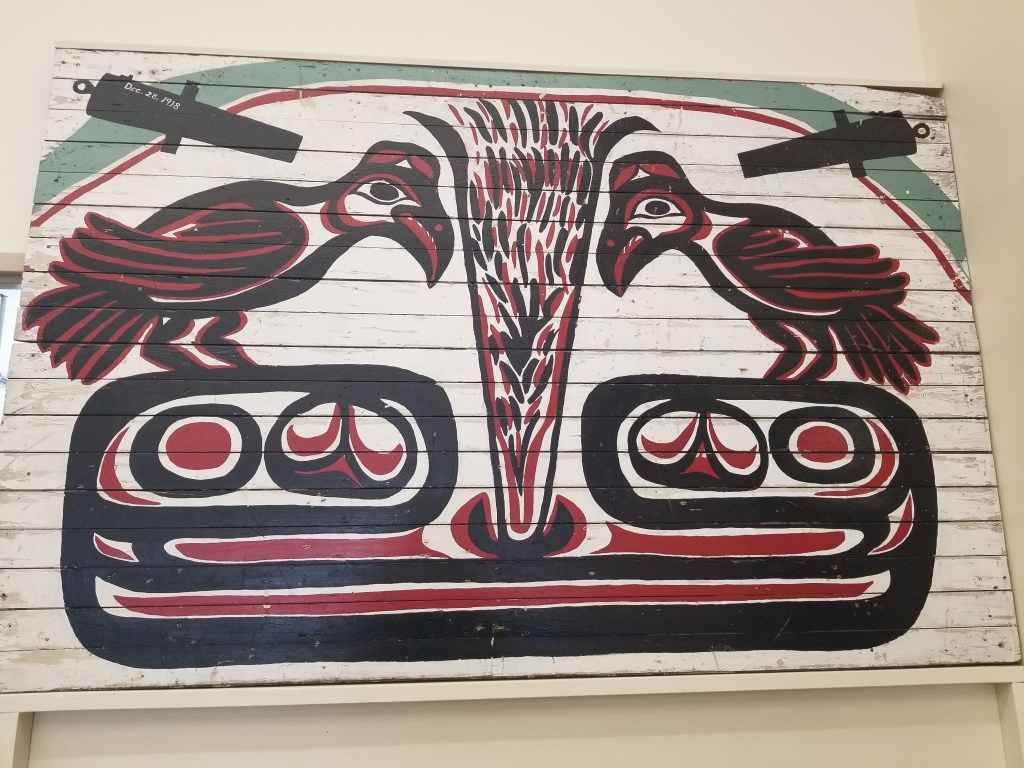
After the ziplining by some and wandering around town by others, we all joined together for a visit to Saxman – a village with many beautiful totems. Here are some photos: (There is a missing piece at the top of the first one.)

Here’s Joe and Tamar with many of the totems in the background:

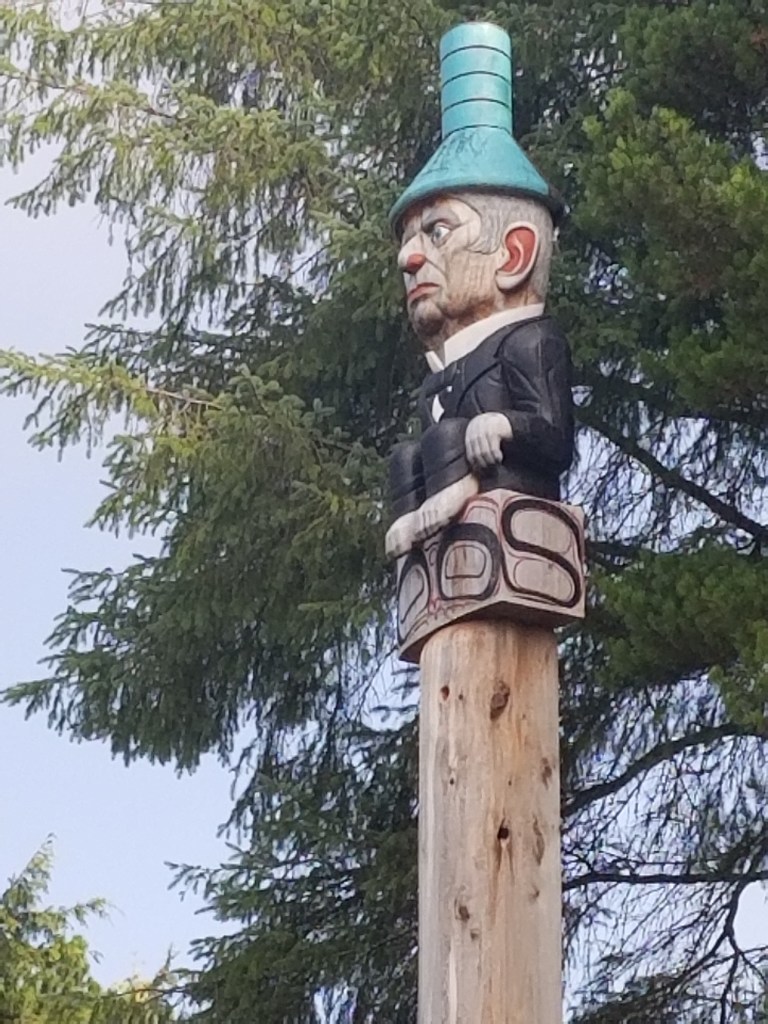
The next totem has a story that goes with it. William Seward (who was responsible for the U.S. “purchase” of Alaska from the Russians) visited the area at one point. The locals put on several potlatches –ceremonies of hospitality with gifts and sharing of food — in his honor. Unfortunately, Seward had no idea that he was expected to reciprocate. As a result, he deeply insulted to the locals, and to reflect their attitude, they built the totem below which shows him as a fool.

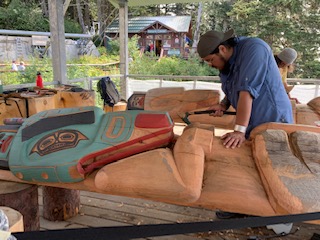
We also saw a demonstration of totem carving, and discussion of the various tools and techniques that the carvers use. The photo here is actually from Juneau, but it illustrates the work:

Here are some other photos, showing images from their work:

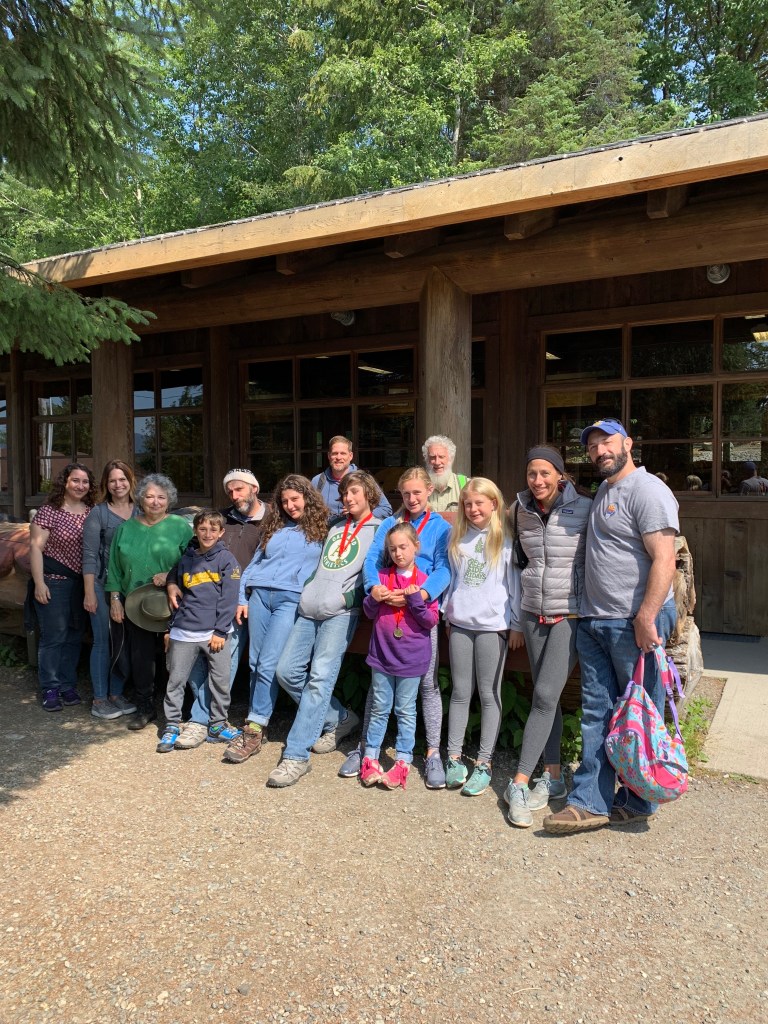
The visit included a presentation of traditional dance in their ceremonial hall. Here we all are in front of the hall:

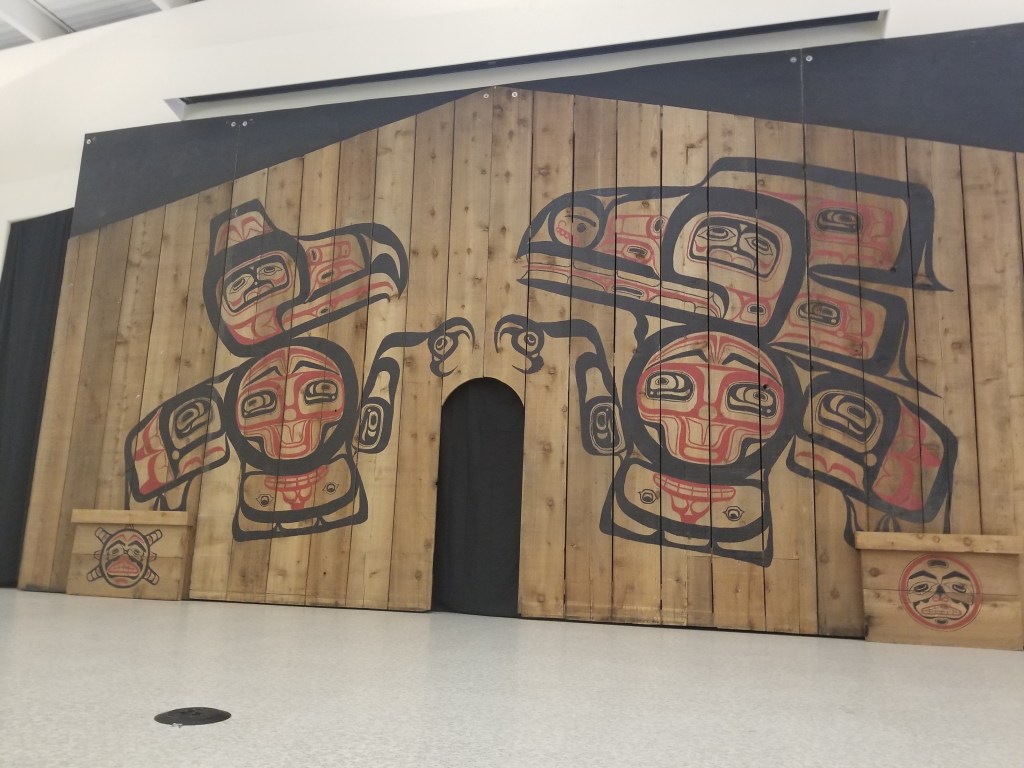
This photo shows the setting for the stage inside the hall:

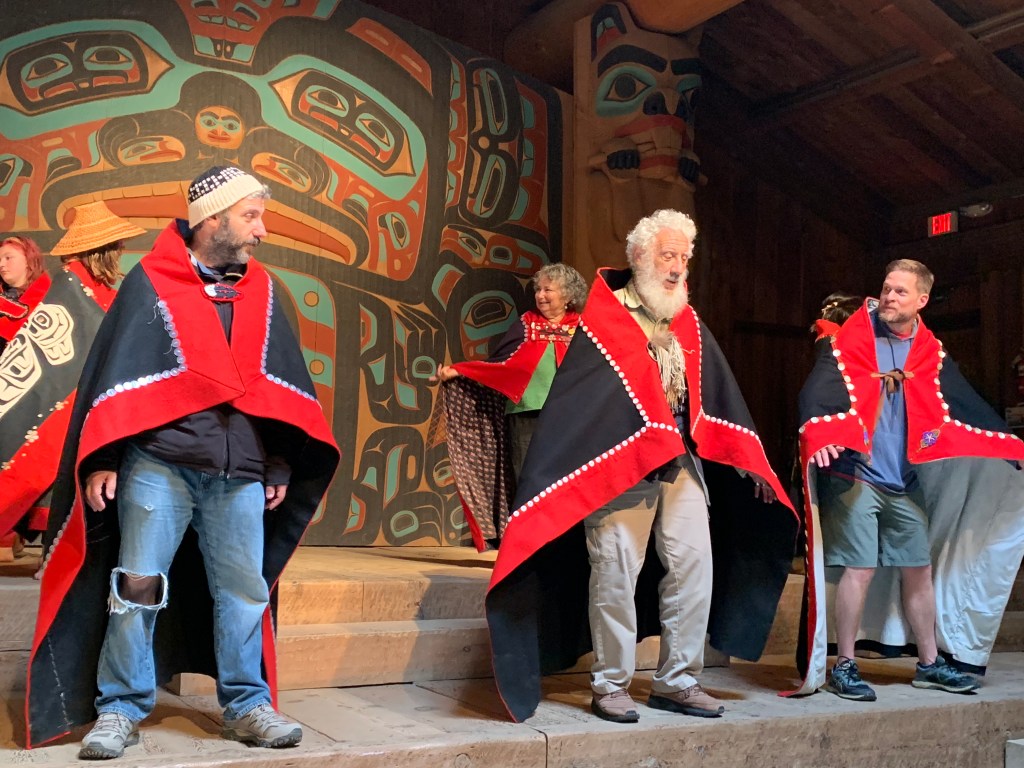
Toward the end of the dance performance, audience members were invited to join in. Joe, Charley, Nina, and I volunteered. (We are all in the photo of the dancing, with Nina in the back.)

At the end of this wonderful day, back to the ship. Juneau, tomorrow.

Post #7: Zip Lining in Alaska – By Ari

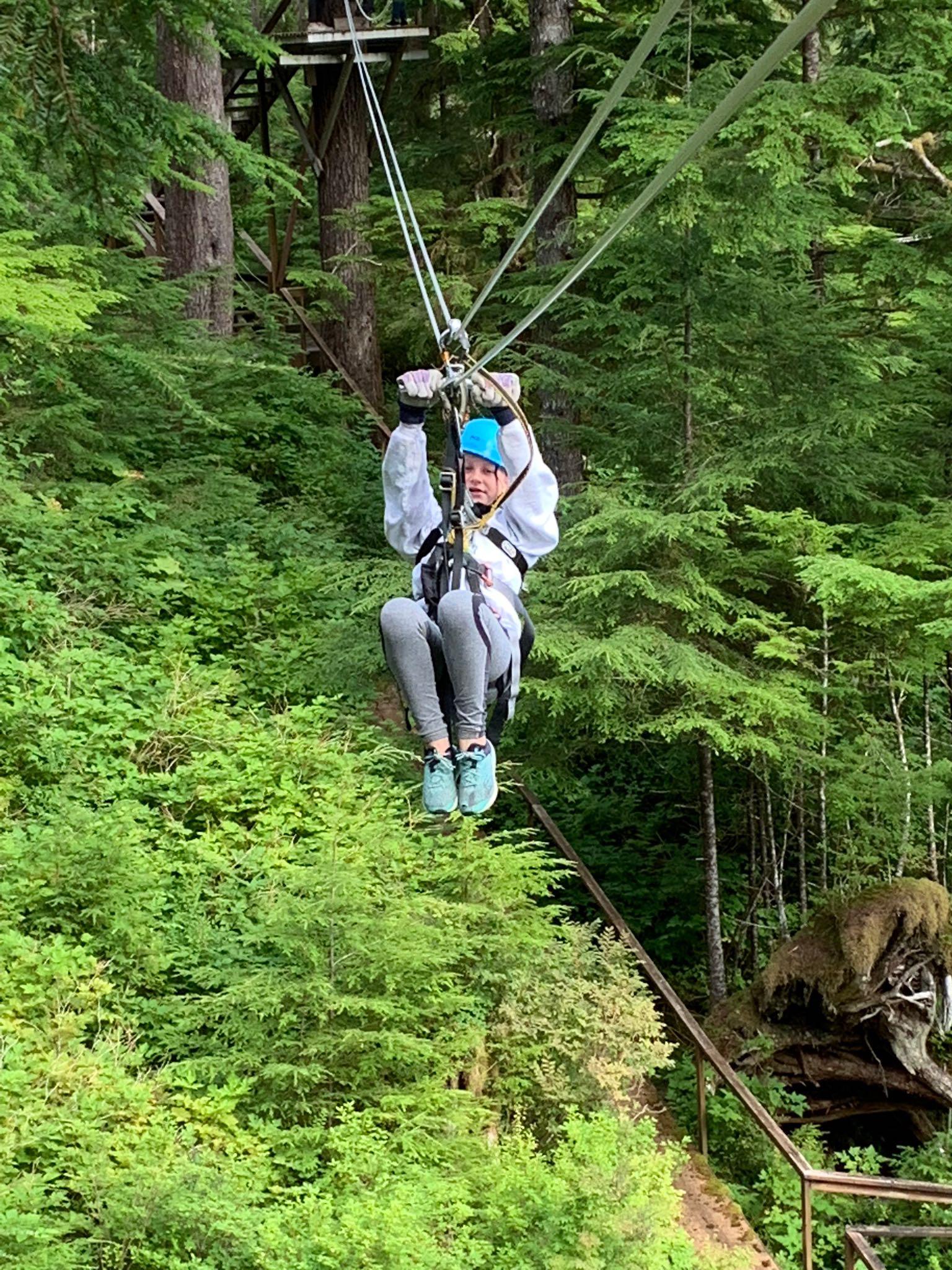
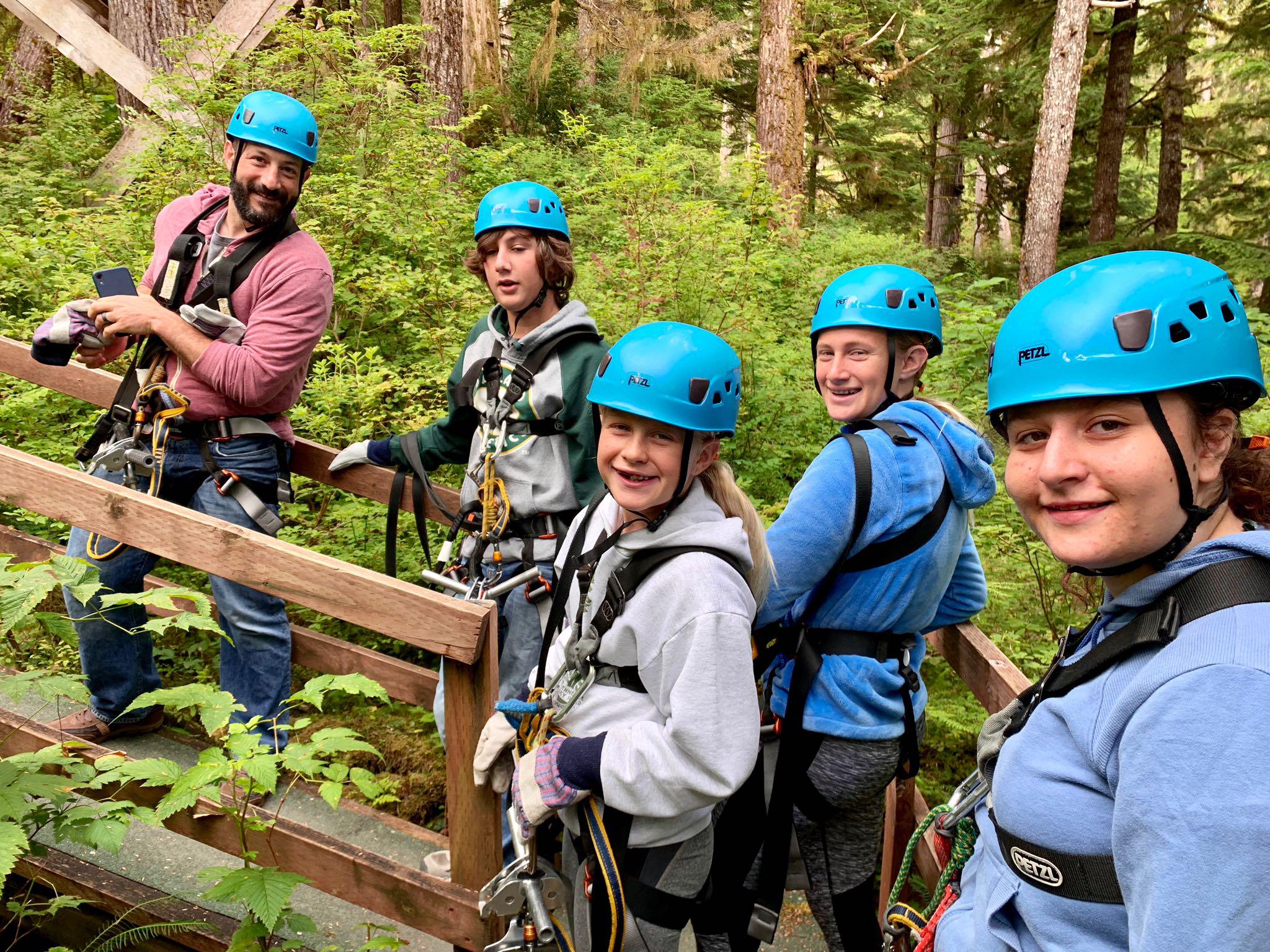
On our first port day in Ketchikan, some of the family got to go zip-lining. We arrived at the site with a few other families. We got our harnesses, helmets, and gloves for safety. The large group of people had to get split into two because there were so many. Our family is very big so our group was us and another nice couple. Then we got a demonstration on how to zip-line correctly. After that it was a lot of fun, we zipped from tree to tree  enjoying the beautiful scenery, along with great thrills. Once we were done we got back on the truck and met up with everyone else. It was an amazing adventure and one I’ll never forget.

Above: Riley zip-lining

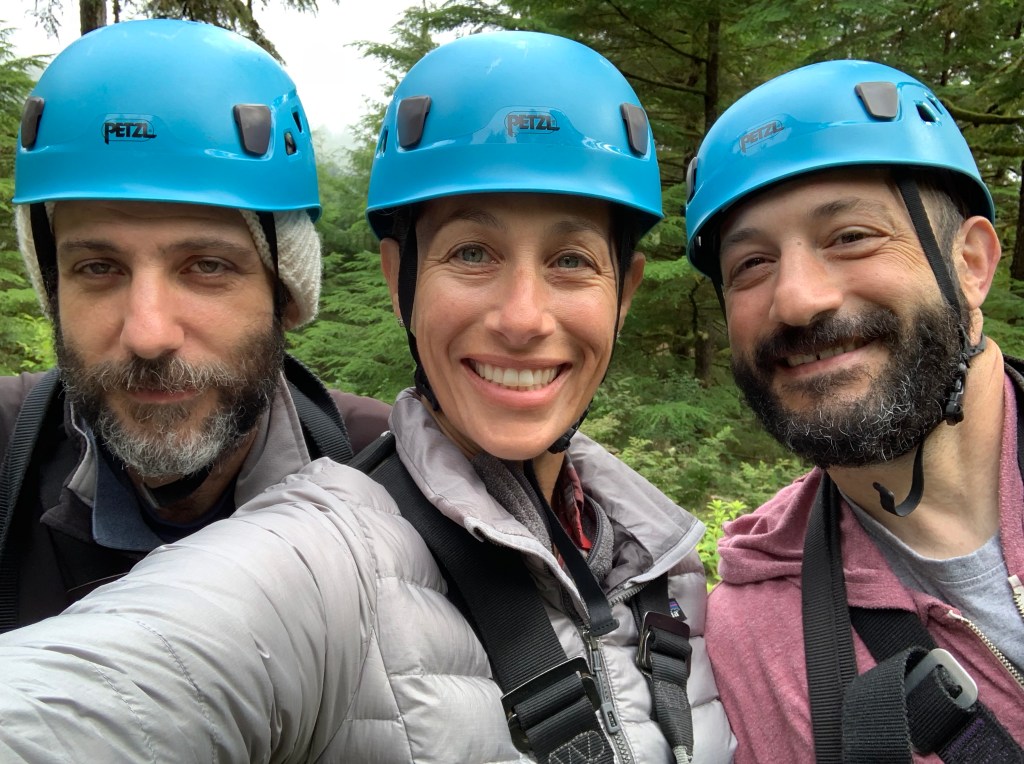
Below: Several of us in our safety gear getting ready to go

Post #6: Cruise Dining – by Tamar

For many people, food is a big draw for cruises. They are notorious for plentiful and accessible food. It is a true pleasure to go on a week’s vacation and have every meal prepared for you!

There were many options for dining on our cruise.

  • The Lido Buffet was open for breakfast, lunch, dinner and late night snacks every day. There was always a large variety of options to choose from. Breakfasts included cold cereals, an omelette bar, various breakfast meats, bagels, crepes, waffles, pastries, smoked fish, oatmeal, juices, fresh fruit and more. Lunches and dinners featured a salad bar (I think Ari and Amir ate caesar salads with seared ahi tuna every day for lunch!), pizza, pasta, meat and fish, vegetables, sushi and an Asian station that rotated cuisines. There was always a dessert area, with a variety of pastries, ice cream and cookies. The variety and speed were wonderful at the buffet, but some of us found it chaotic at times or challenging to juggle our various plates and bowls while we looked for a seat.
  • Poolside during the day there was a taco bar and a burger stand. These were great options for a bit of a change of pace from the buffet.
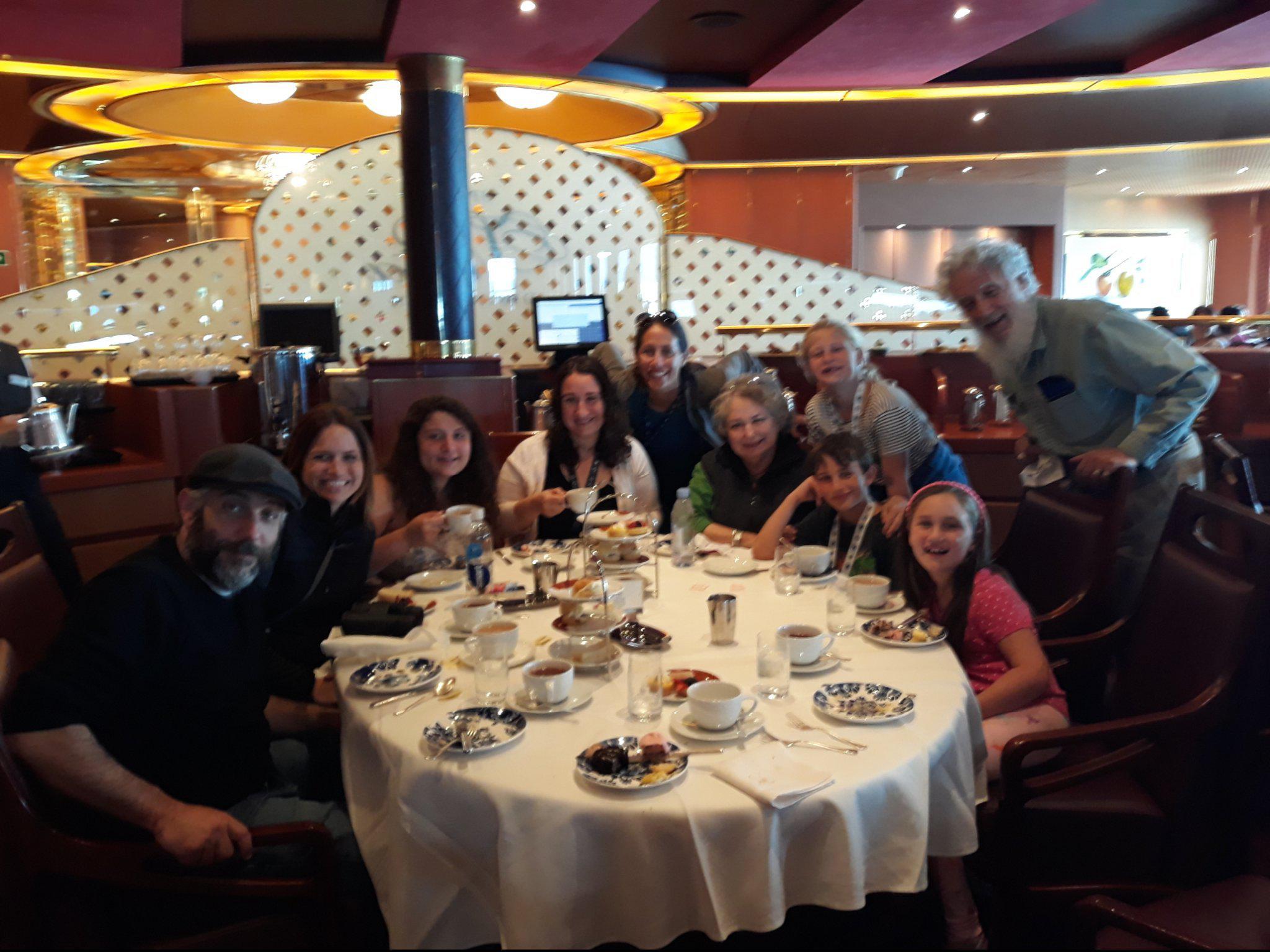
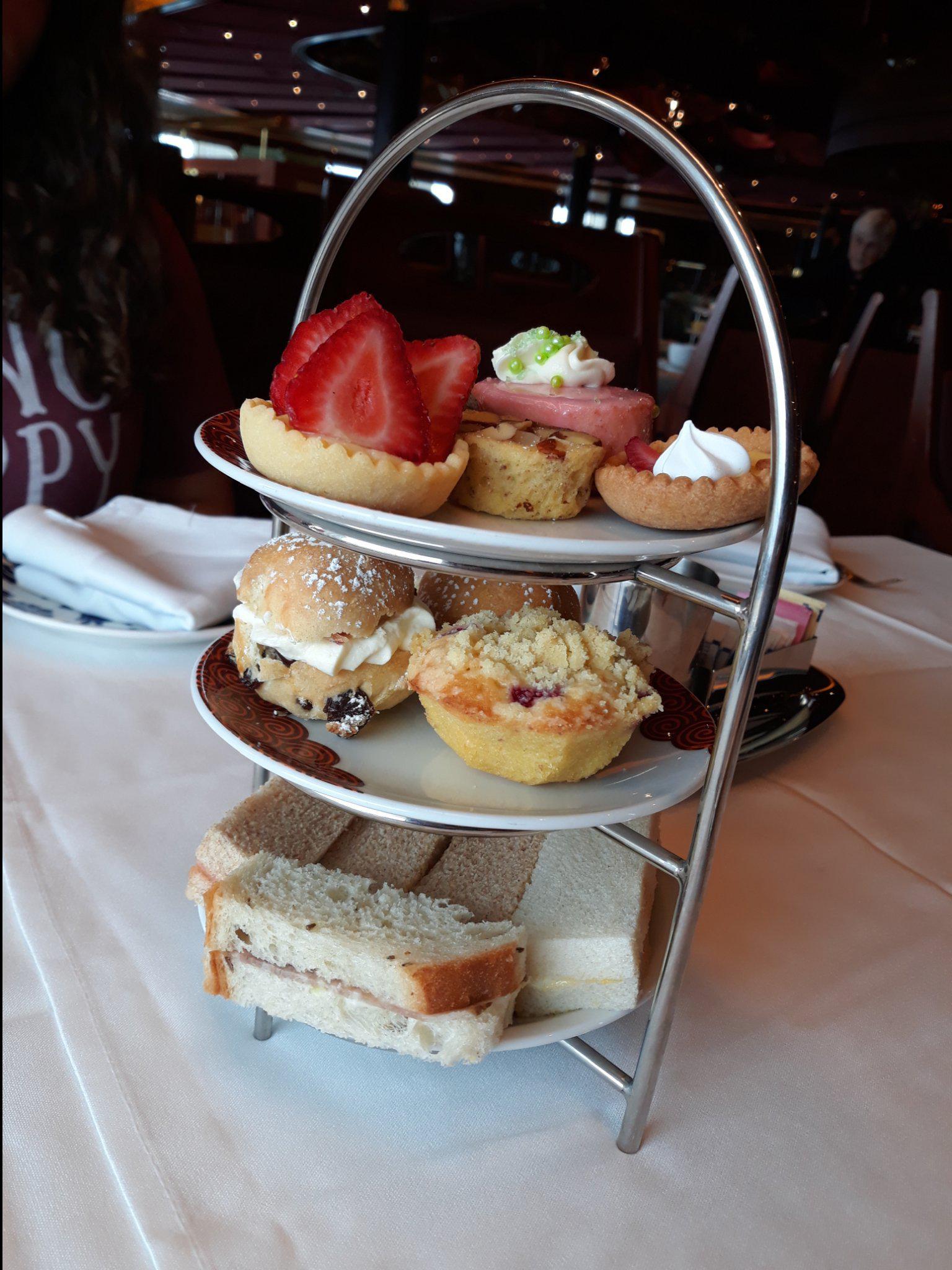
  • The Dining Room is a formal setting for meals, where you order off a menu like in a restaurant. Breakfast, lunch, afternoon tea and dinner were all available in the dining room. For breakfast, there was one menu all week. Afternoon tea is a delightful opportunity for a treat, with a pre-selected three tiered tray of sandwiches, scones, pastries and cookies along with black tea. The lunch and dinner menus changed daily (though a few items, such as Alaskan Salmon, served with capers, dill, brown rice and carrots, were available every day). We had a reservation for dinner as a group at two adjacent tables at 5:30 each evening. This was a wonderful time to connect with one another, along with eat delicious food. (We were delighted when the dining room accommodated us much later in the evening on two of the nights we were in port until the evening.) Depending on the evening, the menu is designed to order or a 3 or 4 course meal. The portions are quite small, but beautifully plated and usually quite good. It is perfectly acceptable to order as many dishes as you’d like – if you would like salad, soup, a steak, fish and two desserts – more power to you! Notably, dress for dinner is somewhat formal – shorts and athletic wear are never allowed, and on the two “gala nights” formal wear is expected.
  • There were a few options for “elevated” dining. For an additional fee you could eat lunch or dinner in a steakhouse or Italian restaurant style location. None of us tried these.
  • Room service, with a limited menu, is available 24/7 with no additional fee.
  • There were a number of bars and a cafe on board, where folks could purchase alcoholic or specialty coffee drinks.
AT

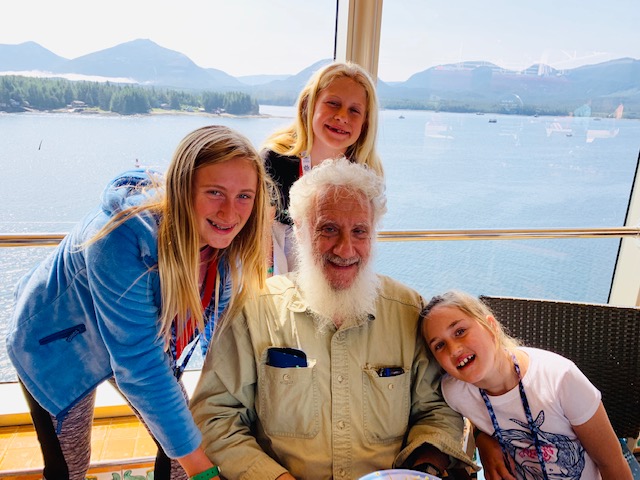
Above: The group at tea one afternoon.

Below: A close up of the treats provided at tea.

Above: Eating lunch poolside – our favorite day time spot.

I was very impressed with the dining staff’s dedication to accommodating every person’s needs. There was good labeling of foods at the buffet, and staff were always willing to answer questions. In the dining room, our waiters worked to get to know us and find out if we had any restrictions or allergies. After an initial misstep (the very first dish I was served was topped with sunflower seeds, though I had stated minutes before that I was severely allergic to them) our main waiter gave me special treatment – having me pre-order my dinner for the next day and looking over my dishes to ensure all was well. There were always vegetarian and vegan options. Every request for a substitution or special dish was accepted with a smile. (For example, the kids often ordered “plain” fish or chicken instead of the elaborate dishes offered in the dining room). Children were always welcome to order from the kids’ menu and adult menus as they wished.

Food safety and sanitation are clearly high priorities (which as a pubic health professional I certainly appreciate!). There are hand sanitizing stations at every entry to dining venues. Salad bars and hot bars are almost always staffed by kitchen professionals, which is a great way to cut down on exposure. There are even signs up wherever raw/undercooked food is served (e.g. sushi) alerting guests to exercise caution.

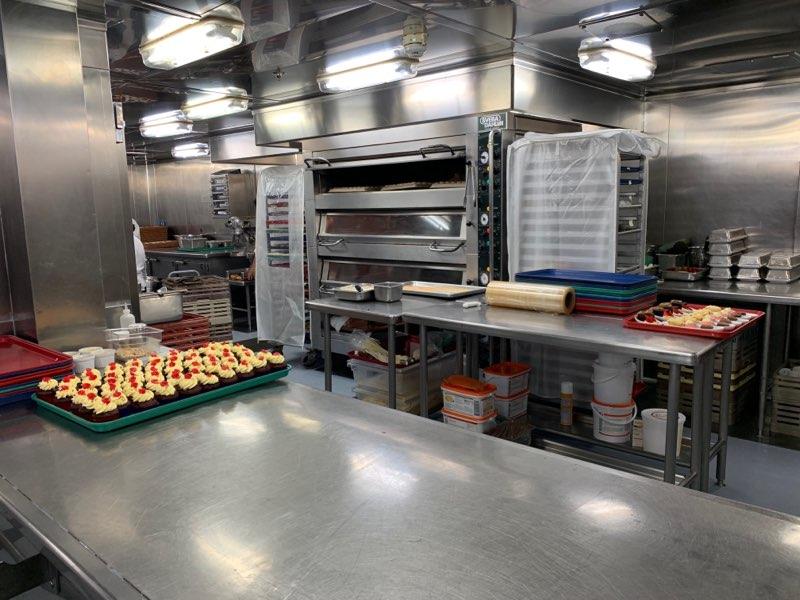
On the first and last days that were spent at sea, guests were invited to participate in a kitchen tour (as long as you were wearing closed toed shoes and certified that you were not sick). This was an eye opening way to learn about the impressive machine behind providing approximately 9000 meals each day.

The kitchen is split into multiple areas, used to prepare different types of food. There are sections for salads, cold appetizers, hot appetizers, hot line (most main dishes), sauces/soups and a pastry kitchen. There is a designated area for coffee brewing (drip and espresso) and a large dishwashing station. There is even a small kitchen dedicated just to room service. Considering the volume of food prepared, each kitchen area is quite small. There is incredibly efficiency in the use of space and equipment. I was particularly impressed with posters that had a photo of each dish they serve, along with the ingredients. In my line of work (health care quality improvement) we would refer to this as a visual management system, and it is a key tool for standardization and sharing information.
d

Photo above: The pastry kitchen, with trays of treats ready to go out.

Overall, the food was delicious and plentiful! We enjoyed the variety and service. I especially loved seeing our kids try some new foods. Now we are all adjusting back to cooking and cleaning up for ourselves, along with eating reasonable portions of healthy foods.

Post #5 – Shuffleboard (by Amir)

Shuffleboard is lots of fun. In shuffleboard you need skill, strategy and strength. Also, you can play with many people at once – up to four. There was shuffleboard on the sports deck of the boat, which was Deck 10. You could see amazing views from up there. 

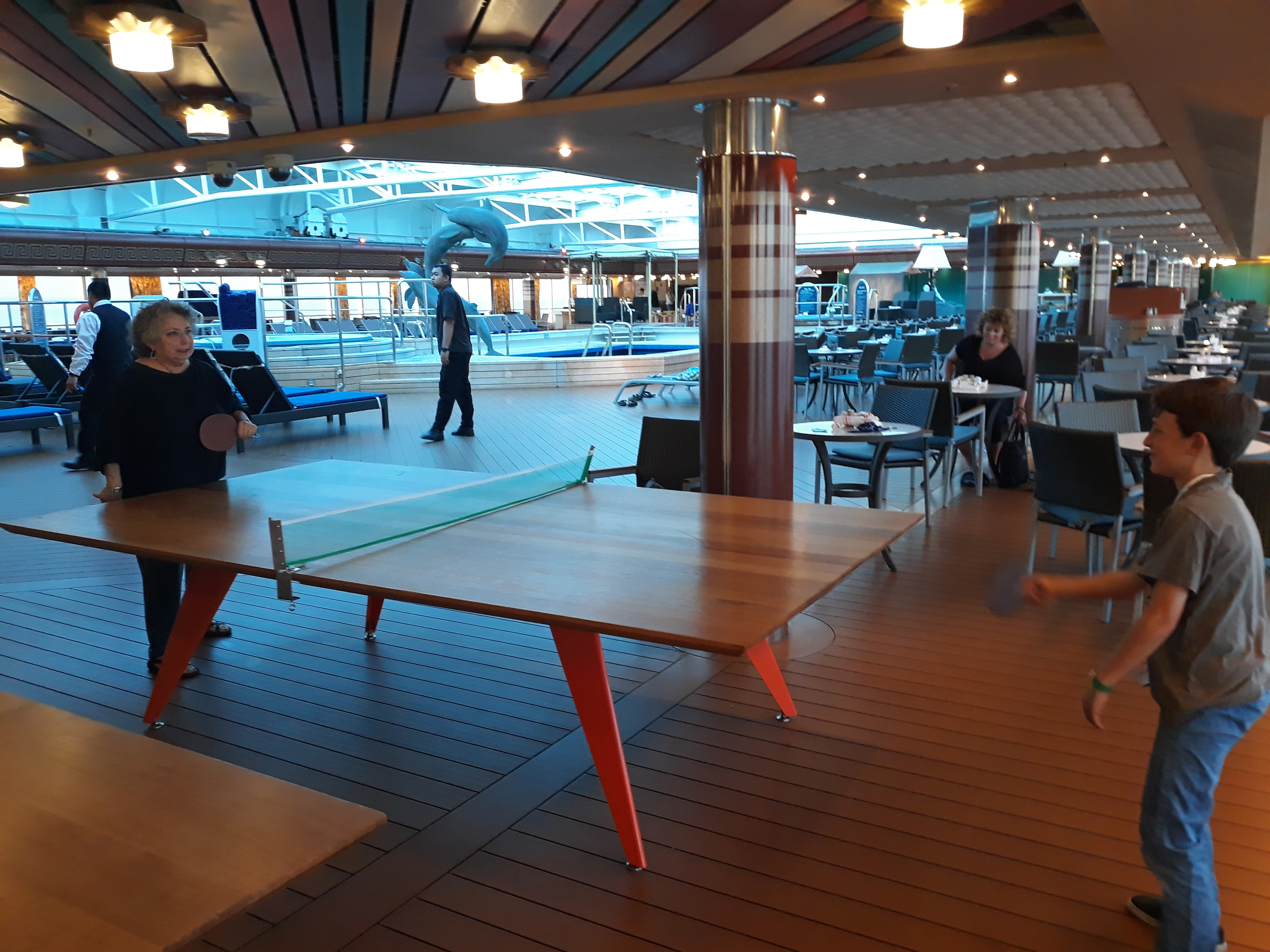
We didn’t take a picture of shuffleboard, so here is a picture of ping pong, another fun activity on board the ship. I played so many games of ping pong on the cruise. I especially loved playing with Nana – she’s surprisingly great at ping pong! The only bad thing is we weren’t allowed to play ping pong when we were cruising Glacier Bay. It’s against the rules because it would be really bad if a ball went overboard into Glacier Bay.

Post #4: Denali

<FYI – All the posts prior to this one were composed by Dan (with a few small edits based on info from others). This post is also primarily Dan’s work, with the italicized text in this post representing Nina’s contribution. We hope to have fuller contributions from others soon.>

Although I’ve labeled this “Post #4,” it’s out of sequence of our trip. Rather than be constantly looking way back, I’m jumping ahead to what we’re doing now (or rather, what we’ve done in the past few days). I hope to get the blog caught up eventually with posts from the rest of the cruise.

We finished our 14-person journey on Sunday, 8/11, in Seward, and went in four different directions.

* Becky and family were picked up at the dock by Charley’s sister, Emmy, and her son, Casey, and they all went on to Homer, where Emmy and family (including husband Ted and daughter Elsa) have lived for quite a few years.

* The rest of us took transportation to Anchorage (which included a stop at a wildlife center that cares for injured animals). From Anchorage:

—Six people (Ben and his family, and Tamar and her two boys) went home to the Bay Area on a late afternoon flight to SFO.

—Joe and daughter Shoshana took a redeye to the east coast, where they will do some college visits (Shosh is starting her senior year of high school), and also do some kind of puzzle contest adventure.

—Nina and I stayed in Anchorage two nights, and then took the train Tuesday morning to Denali, from which we’ve just returned to Anchorage. We drive to Homer tomorrow and will rendezvous with the others there.

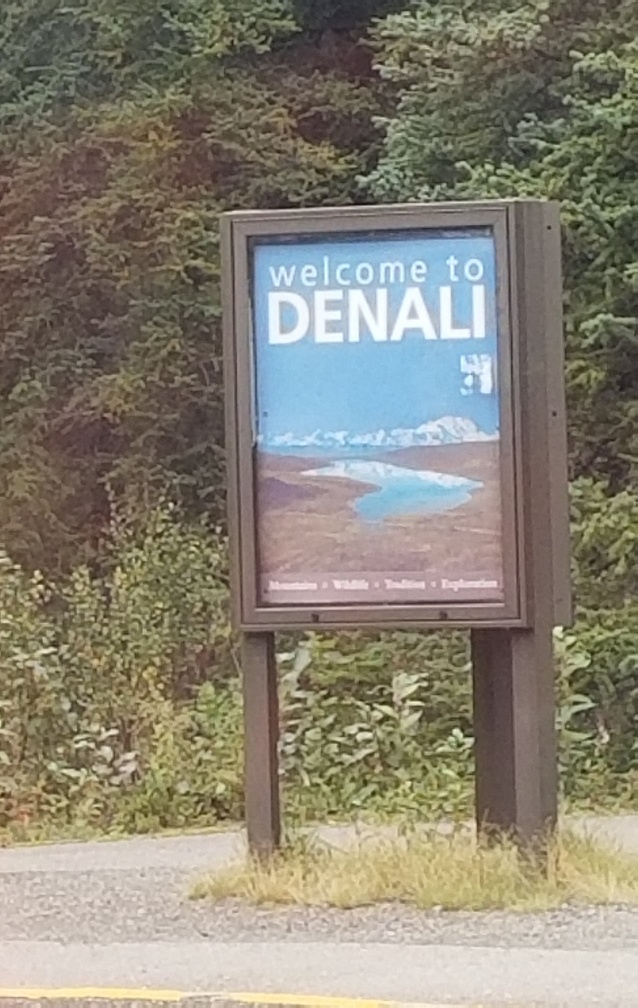
So — about Denali (once known as Mt. McKinley, for no good reason):

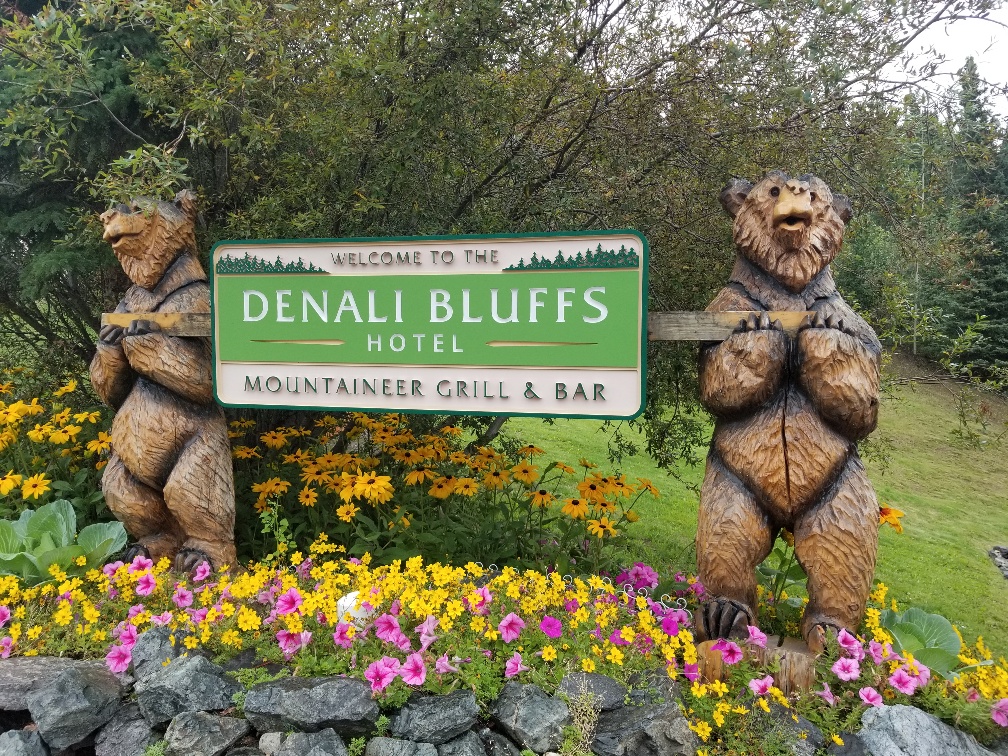
We arrived Tuesday evening, checked in at our hotel

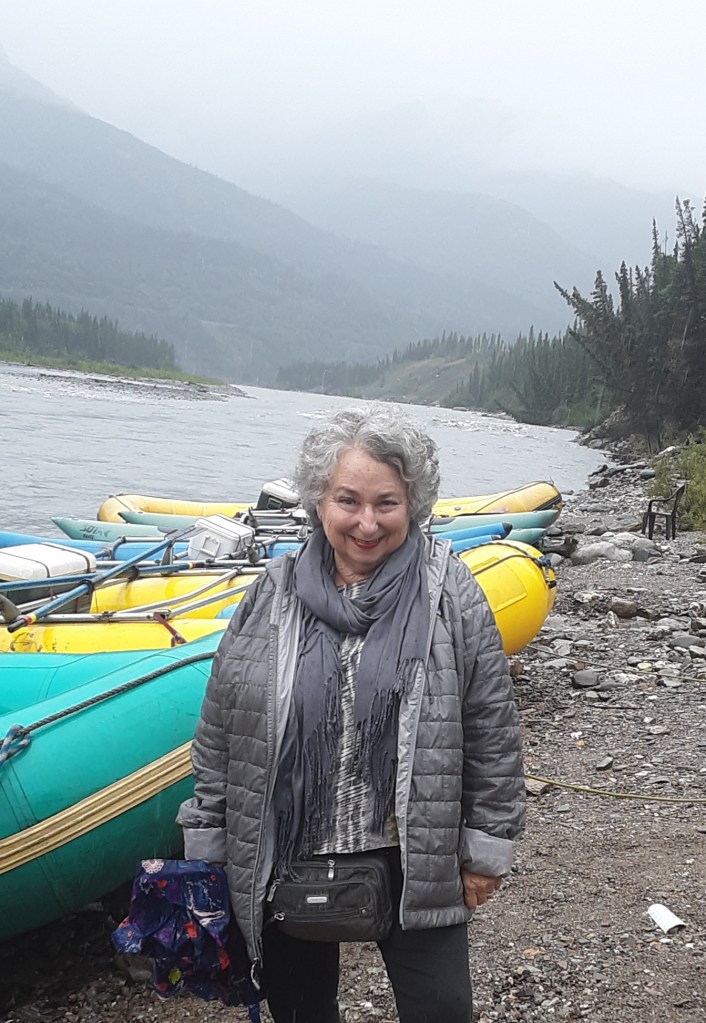
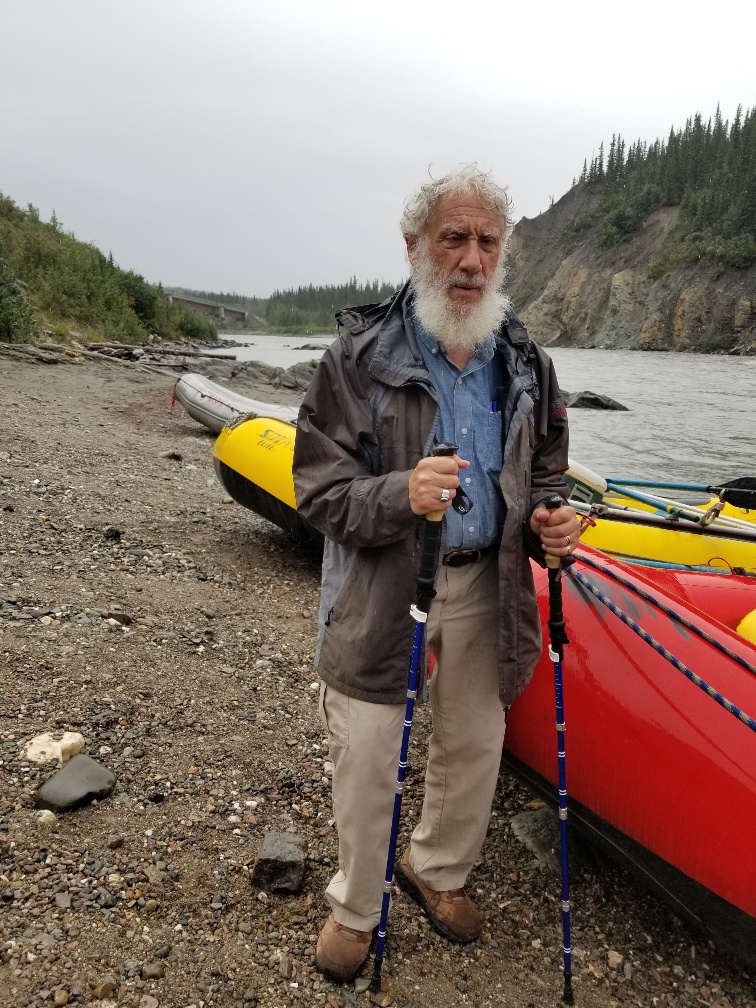
and went for a wonderful walk that took us down to the Nenana River, (Because of its Nana-Nina like name, I tried to get shot of one of the signs for the river – we crossed it in buses many times – but never got a coherent photo.) Here are shots of each of us down by the river:

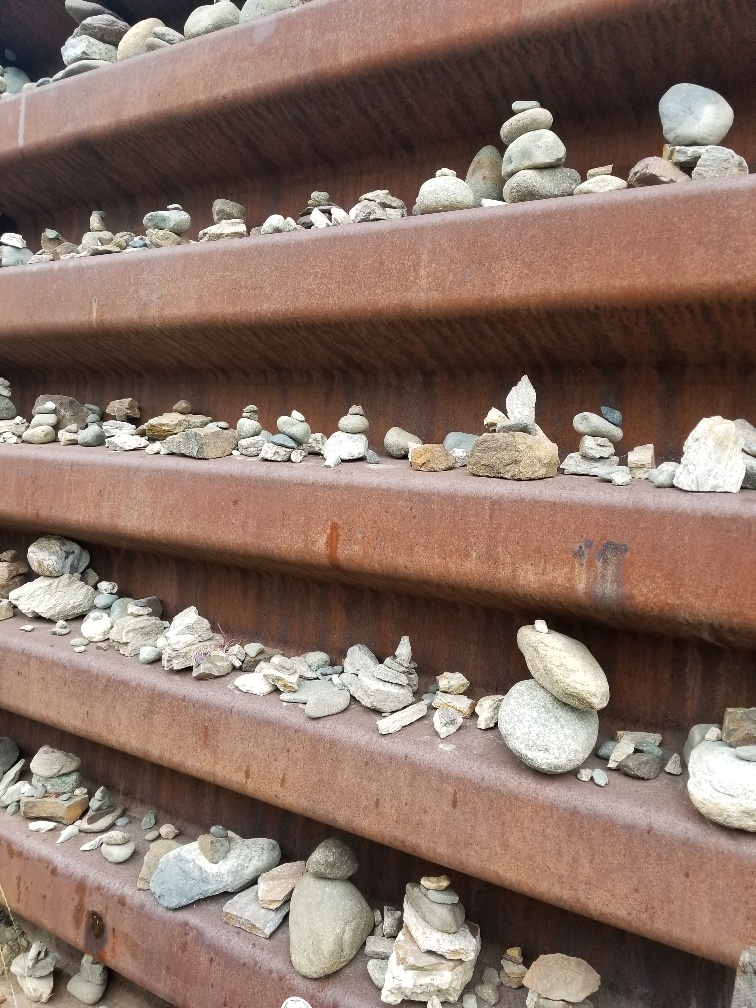
Along the way, we came across this piling up of rocks, built into a retaining wall of the road above, that went on for about 100 feet.

On Wednesday morning, we set out by bus with about 36 others on a full-day Tundra Wilderness Tour, with a wonderful guide/driver, named Bill, who was initially a wildlife photographer and has been working in the park for at least 30 years.

The bad news from the tour: It was too overcast for us to see the majestic mountain, 20,000+ feet high. (Our tour itself was generally at about 4000 feet.)

The good news: We saw lots of wildlife: moose, caribou, bears, and dall sheep (which are the “signature animals” of Denali), as well as lots of birds (including – this is for Josh and Barbara – ptarmigan).

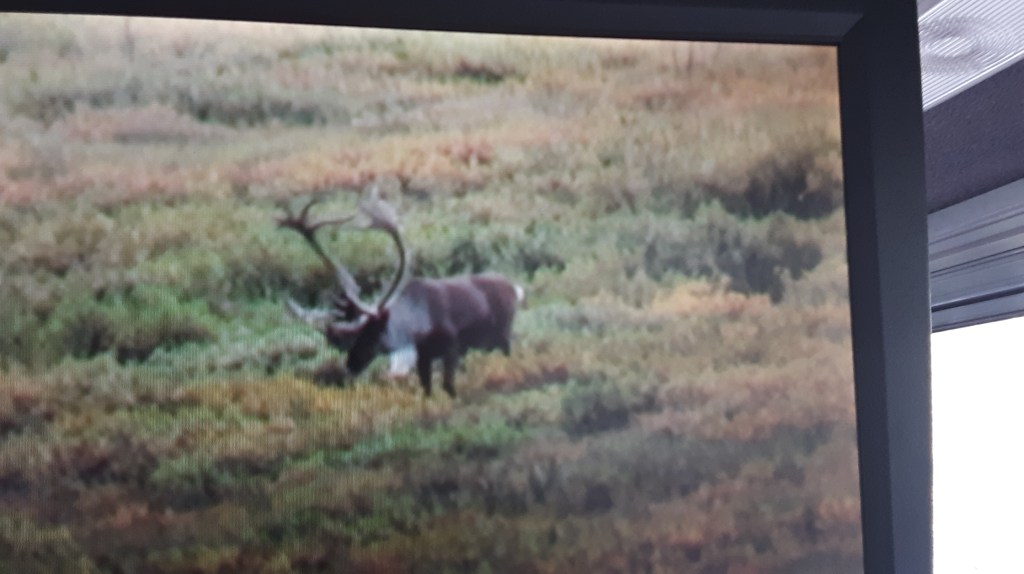
The bus was equipped with screens that were connected to the driver’s powerful camera, so even when we couldn’t see the wildlife clearly directly, we could see the animals close-up on the screen via his camera, and then could take photos of the screen. I’ve included one such shot.

One special sighting was of a brown bear scurrying down a hillside, maybe 500 feet away. (Some very sharp-eyed passengers, with powerful binoculars, would shout “stop” whenever they saw something.) The bear got to the bottom of the hillside, and proceeded through the brush toward us, and eventually crossed the road right behind our bus. Unfortunately, we were at the front of the bus, and he was hidden in brush just before he reached us, so we didn’t get a close-up photo.

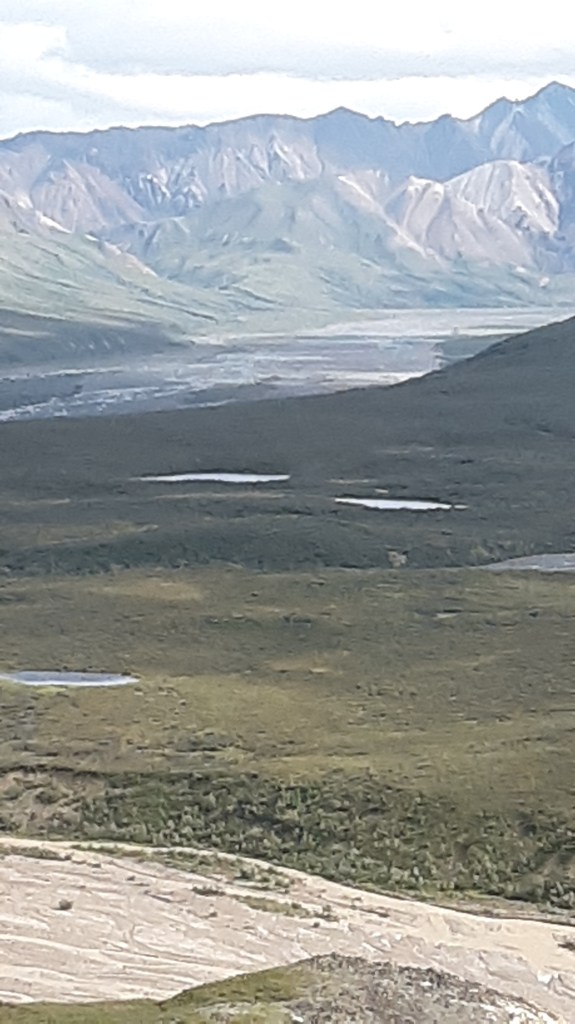
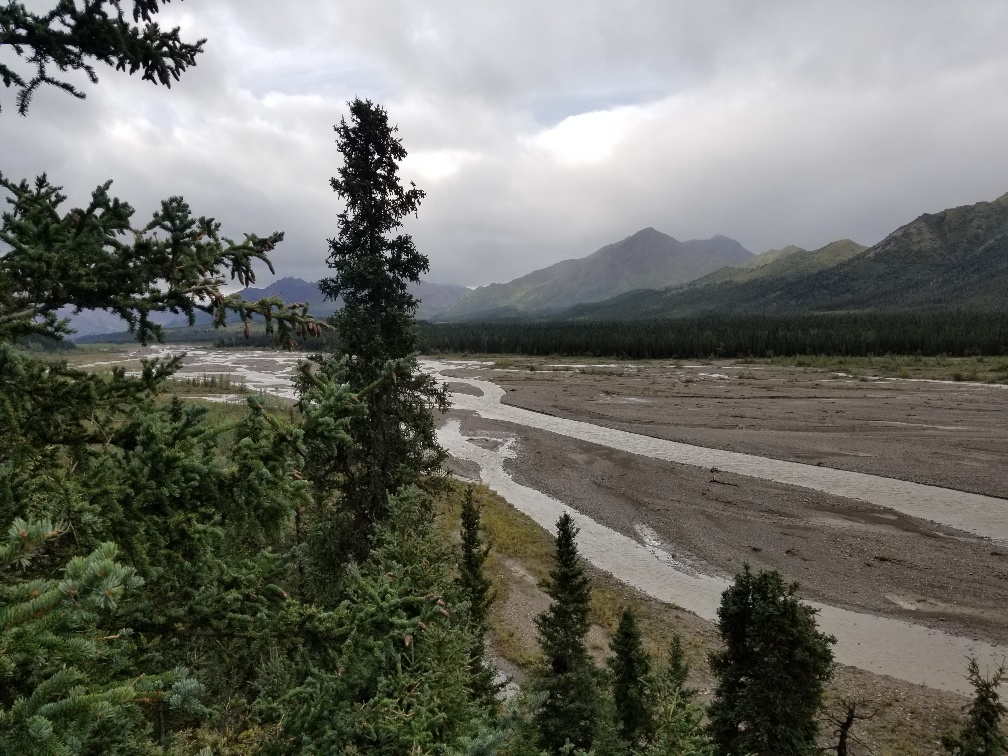
Here are some of our best photos from the bus tour, including a few wonderful vistas (but, as I said, not Denali itself).

This shot, as you might notice, is of the in-bus screen. That’s a caribou.

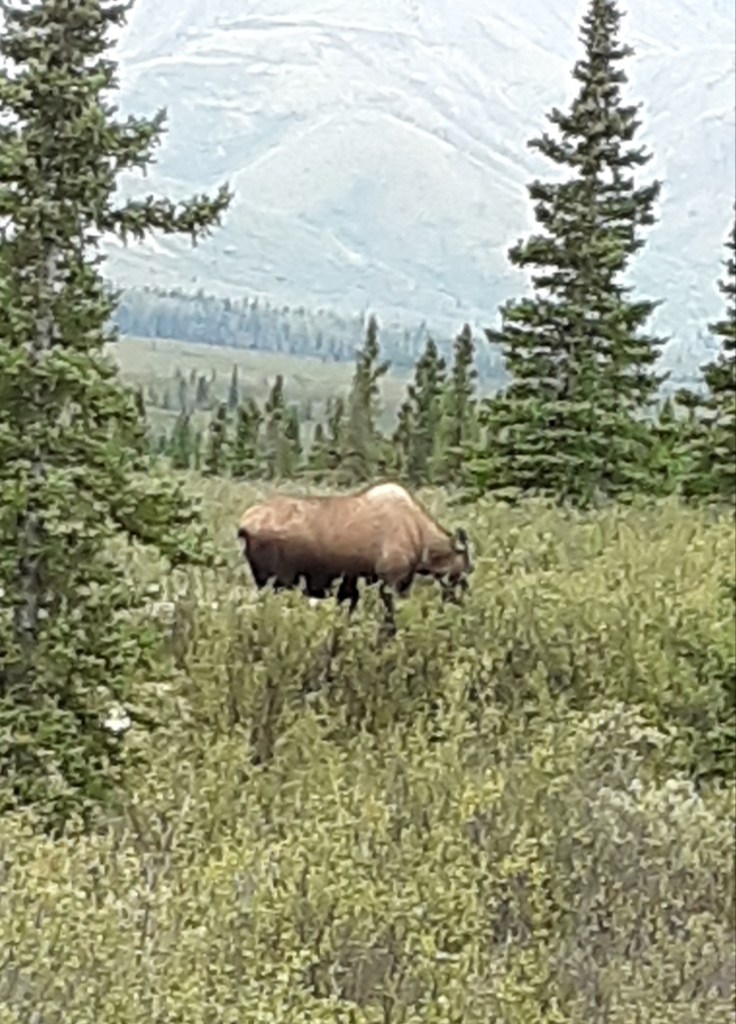
Here’s a moose (which has the recognizable hump, and a more elongated head than a caribou):

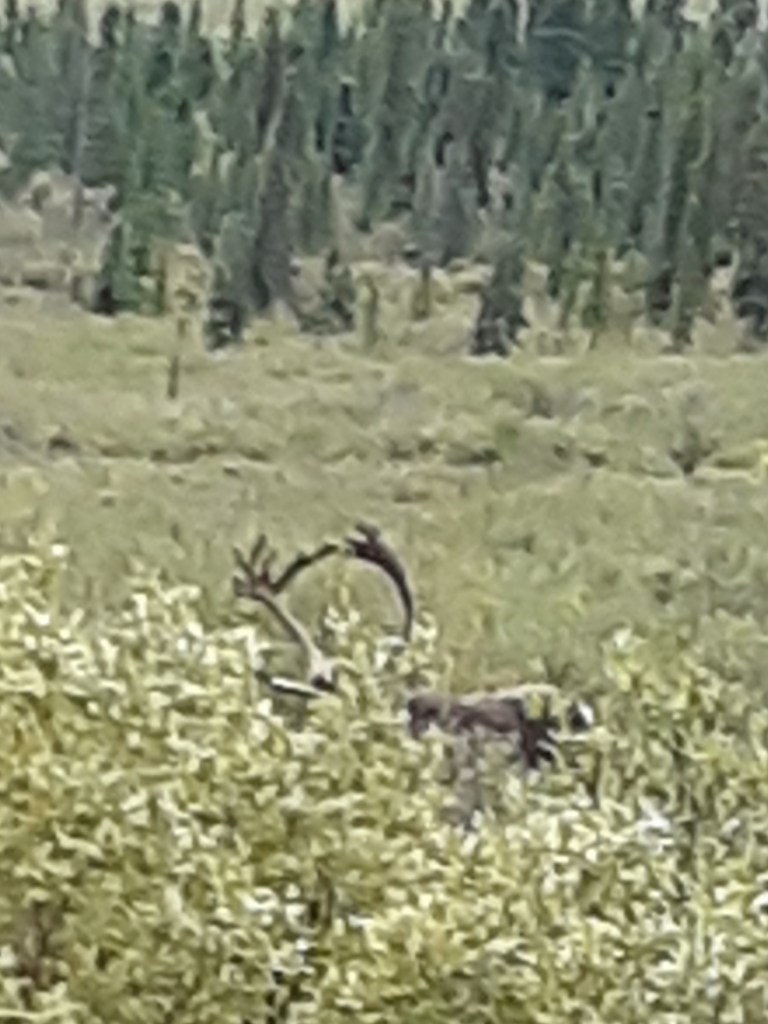
Another caribou, partly hidden (but you can see the antlers):

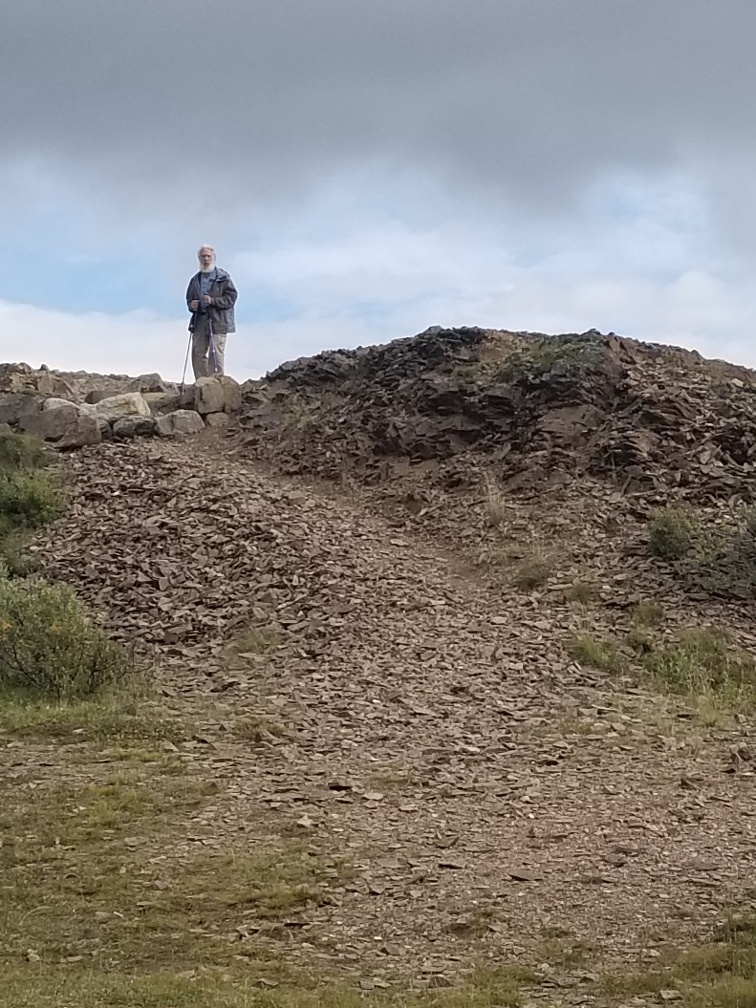
Dan, on a hillside off the side of the road:

And two vistas:

Climate Change in Alaska:

Alaska is the canary in the coalmine for global warming.  Permafrost, which starts around 5 feet under tundra and can extend down for 50 feet, is melting at a rapid rate. Communities are losing usable land. Roads and buildings are buckling under the strain of the melting permafrost.

Shorelines are changing. Warmer water temperatures disrupt the fish that feed species like salmon and seals, which in turn disrupts the economics of entire fishing communities and the economic viability of the industry and way of life. The problem is everywhere you turn here.

Our last evening in Denali:

Wednesday evening, we went to a slightly hokey musical show, including dinner, with songs and stories about Alaska. We were greeted at the door by one of the performers doing a dramatic reading of Robert Service’s “The Cremation of Sam McGee” (which I probably last encountered in 7th grade or so). It’s one of my all-time faves. The young actors also waited on tables for a family-style meal (delicious and efficiently served), had some beautiful voices and several with real acting chops.

Post #3: About the Ship

We sailed on the Noordam, on the Holland-America line, with over 1900 other people (not counting crew, who were ubiquitous, numerous and fabulous). It took several days to get a sense of where everything was – multiple eating facilities (food available virtually 24/7); small meeting rooms (where we played Family Feud and other games – more on that in another post); two swimming pools and hot tubs, larger auditorium-like venues (for music, educational talks, comedy nights, etc.), and so on. Plus (re)learning “port” and “starboard.”

Here are a couple of ship shots:

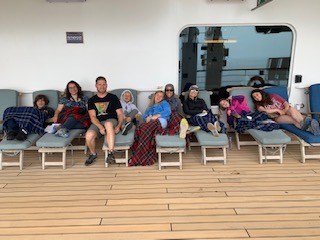
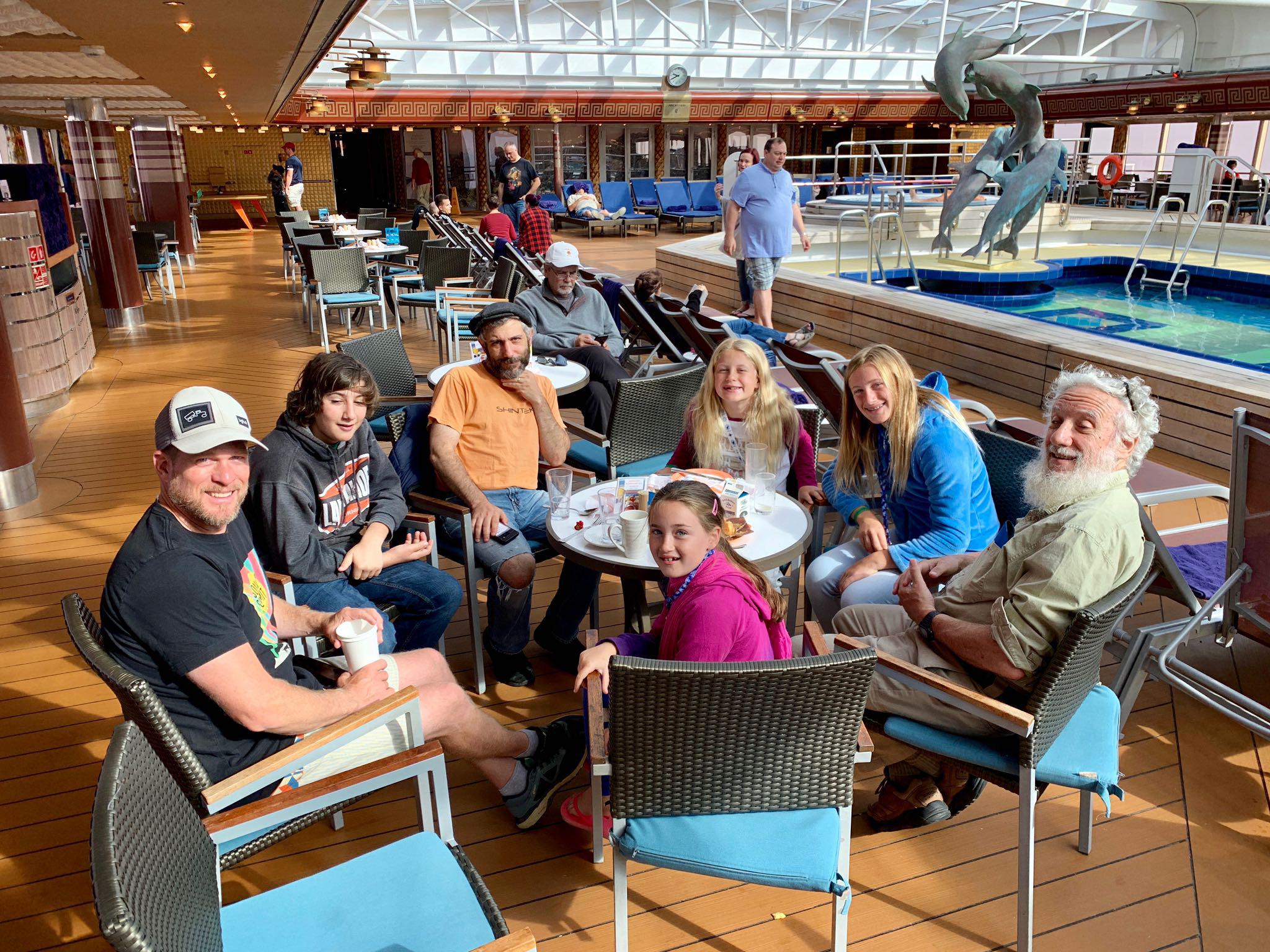
* A bunch of us lounging on the promenade deck (Deck 3, on which you could walk all the way around the ship; 3 laps = 1 mile)

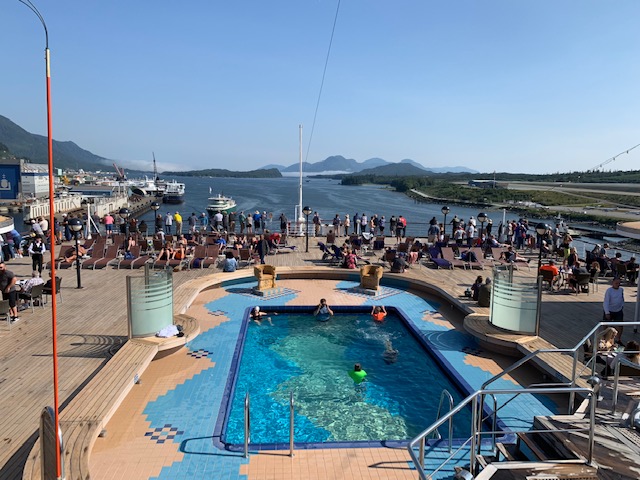
* The pool on the rear Lido deck (Deck 9) (although we mostly hung out at the front Lido deck pool – no smoking allowed). This was taken as we pulled out of Ketchikan, which was our first port after leaving Vancouver. We spent Tuesday (8/6) there — see post still to come.

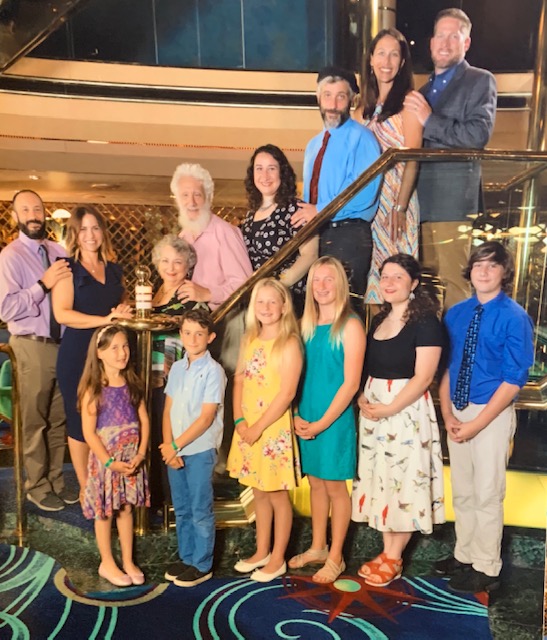
* All of us on the Monday night “Gala night” dinner (This is a photo of the photo the ship’s photographer took.)

Design a site like this with WordPress.com
Get started